
Lviv – The Zvenyhorod Heritage: Part III: The Birth of the “New” City

Article Sidebar

Main Article Content
Abstract
This article examines the historiographical and documentary evidence concerning the emergence of the so-called “new” city of Lviv and, in particular, the authenticity and chronological significance of a diploma attributed to King Casimir III the Great and traditionally dated to August 22, 1352. The study critically evaluates interpretations that use this document to argue for a pre-Casimirian municipal incorporation of Lviv during the reign of Prince Lev Danylovych. Particular attention is given to the identification of the advocate Berthold, the estates associated with the Stecher family, the toponym “Schilzkikut,” the chronological formula of the diploma, the royal itinerary, witness lists, royal titulature, and selected material features of the parchment. The analysis compares the disputed Lviv document with the authenticated diploma issued by Casimir III near Szczebrzeszyn on August 23, 1352, while also considering alternative explanations proposed in earlier scholarship, including the possibility of a two-stage chancery procedure or an earlier oral legal act followed by later formalization. The evidence discussed in the article raises substantial chronological, diplomatic, genealogical, and material questions concerning the traditional dating and authenticity of the Lviv document. The article argues that these issues should be evaluated through a distinction between directly attested evidence, historiographical interpretation, and hypotheses concerning the document’s production and subsequent use.
Article Details
Copyright (c) 2026 Szymski AM

This work is licensed under a Creative Commons Attribution 4.0 International License.
1. Mohytych R, Planuvalna struktura lvivskoho seredmistia i problemy yoho datuvannia [The Planning Structure of Lviv’s City Center and the Problems of Its Dating], „Zapysky NTSH”, Vol. 227: Praci sekcii mystectvoznavstva, Lviv 1994, pp. 279–288; ejusdem, Rozvytok urbanistychnoho seredovyshcha Lvivskoho seredmistia u druhiy polovyni 13 – na pochatku 20 st. [Development of the Urban Environment of Lviv’s City Center from the Second Half of the 13th to the Beginning of the 20th Century], Avtoref. dys. kand. arh., Lviv: NULP, 2003.
2. Yu. Dyba, V. Petryk, Planuvalna struktura “dolokaciynoho” Lvova [The Planning Structure of “Preincorporation” Lviv], [in:] Seminiariy “Kniazhi chasy”, Lviv: Manuskrypt, 2002, pp. 40–59.
3. Academic profile of Prof. Mar’yana (Maryla) Dolynska on the Ukrainian Catholic University portal: https://humaniora.ucu.edu.ua/personal/mar-yana-dolynska / (accessed: July 28, 2026)
4. Polish historians and architects consistently point to the methodological weakness of the regressive method when used in isolation from other disciplines: projecting early modern plans (including Austrian maps from the late 18th century) onto 13th- and 14th-century realities is highly unreliable and—lacking solid archaeological verification—prone to overinterpretations conditioned by the current ideological or political-historical context.
5. According to M. Dolynska, it follows from this document, containing the monarch's confirmation of the rights of the advocate Berthold's grandsons to possess a specified estate (a mill, a grange, and a village with a mill and an inn), that the said ancestor received these properties from Prince Lev Danylovych as the acting advocate of Lviv ruling under German law (ius teutonicum). The author considers this proof that at the close of the 13th century, Lviv possessed a developed municipal structure and the institution of an advocate under Magdeburg law.
6. See further: A. Janeczek, Spis urzędników, książka zażaleń. Z powodu pracy Myrona Kaprala, Urzędnicy miasta Lwowa w XIII–XVIII w. [A List of Officials, a Book of Grievances. On the Occasion of Myron Kapral's Work, Officials of the City of Lviv in the 13th–18th Centuries], (Spisy urzędników miejskich z obszaru dawnej
7. Cf. ibidem, p. 178, where the Przemyśl analogy is pointed out, as well as the restriction of the jurisdiction of German law exclusively to the framework of a specific foreign colony.
8. The charter of incorporation for Sanok under Magdeburg law was issued by Bolesław-Jerzy II on January 20, 1339. Barely fourteen months later, on April 7, 1340 (erroneously cited as March 21 in older literature), the king was poisoned in Volodymyr by conspiring boyars led by Dmytro Detko, which initiated the long-standing war over the Galician–Volhynian succession.
9. Defined explicitly as “the beginning of the occupation period that lasted over 400 years” of the lands of "Western Ukraine" (!).
10. An expression of this trend in the public sphere can be found in the author's own appearances; see, e.g., the broadcast featuring Prof. M. Dolynska: Polski mify pro istoriyu Lwowa, yakym bulo misto za knyazhykh chasiv [Polish Myths about the History of Lviv: What the City Was Like in the Princely Era], the "Bez bromu" project, available online: https://www.youtube.com/watch?v=SCmA80BlYrM .
11. Akta Grodzkie i Ziemskie z czasów Rzeczypospolitej Polskiej z Archiwum tzw. Bernardyńskiego we Lwowie [Castle and Land Records from the Times of the Polish Commonwealth from the So-called Bernardine Archive in Lviv] (hereinafter: AGiZ), vol. II, Lviv 1870, no. I, p. 1: “Quomodo molendinum Schilzkikut cum piscina ante civitatem Lemburgensem situatam...”.
12. Already Antoni Petrushevych, in his editorial commentary to AGiZ, was the first to suggest that the distorted term "Schilzkikut" should be read in a Rus' manner as "Selsky-kut" (Сільський кут), meaning "Village Corner/Bend." This shifts the interpretation of this name in the corrupted German language—characteristic of colonists originating from Lower Silesia—toward native (drawn from the Rus' language) toponymy; cf. AGiZ, vol. II, p. 2, fn. 1.
13. His alleged figure as a locator (read: founder of the city) is on display at the Lviv History Museum (the Black House, 4 Rynok Square)—its very presence confirming M. Dolynska's hypotheses derived from discoveries that are downright impossible to prove [but have nevertheless been accepted within Ukrainian scholarship as scientifically confirmed FACTS].
14. K. Liske, Akta Grodzkie i Ziemskie z czasów Rzeczypospolitej Polskiej z Archiwum tzw. Bernardyńskiego we Lwowie [Castle and Land Records from the Times of the Polish Commonwealth from the So-called Bernardine Archive in Lviv] (hereinafter: AGiZ), vol. II, Lviv 1870, no. I, pp. 1–2 (with commentary by A. Petrushevych, fn. 1 on p. 2, pointing to the Rus' etymology Selsky-kut).
15. M. Dolynska, Istorychna topohrafiia Lvova XIV–XIX st. [Historical Topography of Lviv in the 14th–19th Centuries], Lviv 2006, pp. 218–220; see also: Atlas ukrainskykh istorychnykh mist [Atlas of Ukrainian
16. See the media reports: U Lvovi v pidvali avariynoho budynku znaishly reshtky mlyna chasiv zasnovnyka mista [In Lviv, the Remains of a Mill from the Era of the City’s Founder Were Found in the Basement of an Endangered Building], "Lokalna Istoriya" portal, October 25, 2021, available online: https://localhistory.org.ua/news/u-lvovi-v-pidvali-avariinogo-budinku-znaishli-reshtki-mlina-chasiv-zasnovnikamista /
17. In 1387 (or 1389, according to other sources), the Lviv burgher Johann Sommerstein received land from the city to establish a manor [grange?]. The name Sommersteinhof later transformed into Zamarstyniv (the boundary between Lviv and the estate ran along present-day Khemichna and Dashkevycha streets); it is mentioned under the name of "Belz Fields" (Belshchyna) as early as the first chronicle mention of Lviv. Cf. Wikipedia entry for Zamarstyniv: Замарстынов —Википедия
18. Interview with Prof. M. Dolinska in the "Bez bromu" project (https://youtube.com). . The author asserts there that the identification of the estate to the south-east of Lviv is a logical error due to the distance and difficult terrain conditions in the 13th century.
19. The distinct status of Sommerstein’s estate (Sommersteinhof) was regulated at the end of the 14th century, and the subsequent border with the city ran along present-day Khemichna and Dashkevycha streets. This area, formerly referred to as the “Belz Fields” (Belshchyna), already appears in the oldest chronicle mentions [vide fn. 22].
20. Cf. A. Baytsar, Vynnyky davni i suchasni: Istoryko-krayeznavchyi narys [Vynnyky Ancient and Modern: A Historical-Local History Outline], Lviv 2012; idem, Istoriya Vynnyk v osobah [The History of Vynnyky in Personalities], Vynnyky 2017.
21. The document of Vladislaus II of Opole, issued in Lviv on October 1, 1378; see AGiZ, vol. III, no. XXV, pp. 42–43.
22. M. Dolynska, Nerukhomist' nimec'koji rodyny Shtekheriv v piznoserednovichnomu L'vovi: tradycijnyj ta interdyscyplynovyj pohliad [The Real Estate of the German Stecher Family in Late Medieval Lviv: A Traditional and Interdisciplinary View], [in:] Fenomen mul'tykul'turnosti v istoriji Ukrajiny i Pol'shchi. Materialy mizhnarodnoji naukovoji konferenciji, Kharkiv 2016, pp. 61–66 (especially pp. 64–65); eadem, Pochatky prostorovoji lokaciji L'vova v ostannij tretyni XIII stolittia [The Beginnings of the Spatial Incorporation of Lviv in the Last Third of the 13th Century], „Misto: istoria, kul'tura, suspil'stvo”, no. 6 (1), 2019, pp. 39–46 28 / Cf. footnote no. 21.
23. Published in its entirety for the first time in 1870 in AGiZ, volume II, doc. 1, pp. 1–3; also in, among others: Oleh Kupchynskyi, Akty ta dokumenty Halycko-Volynskoho kniazivstva XIII — pershoi polovyny XIV stolit: doslidzhennia, teksty [Acts and Documents of the Galician–Volhynian Principality of the 13th – First Half of the 14th Centuries: Research, Texts], Lviv 2004, No. 9, pp. 773–776.
24. B. Zimorowicz, Potriynyi Lviv / Leopolis Triplex [Triple Lviv], trans. from Latin by N. Careva, Lviv 2002.
25. J. Alnpek (Alembek, Alnpekius), Topographia civitatis Leopolitanae... [Topography of the City of Lviv...], [in:] S. Rachwał, Jan Alnpek i jego „Opis miasta Lwowa” z początku XVII w. [Jan Alnpek and His "Description of the City of Lviv" from the Beginning of the 17th Century], Lviv 1930.
26. T. Pirawski, Relatio status Almae Archidioecesis Leopoliensis [Account of the State of the Holy Archdiocese of Lviv], ed. C. Heck, Lviv 1893.
27. D. Zubrzycki, Kronika miasta Lwowa [Chronicle of the City of Lviv], Lviv 1844.
28. S. Kętrzyński, O elementach chronologicznych dokumentów Kazimierza Wielkiego [On the Chronological Elements of Casimir the Great’s Documents], Kraków 1913, pp. 132–133. Characteristically, this researcher considered another document published in the second volume of AGiZ (designated as No. II, an alleged 1359 privilege which was supposed to bear the oldest surviving seal of the Lviv municipal council) to be an absolute forgery.
29. K. Sochaniewicz, Herb miasta Lwowa [The Coat of Arms of the City of Lviv], Lviv 1933, Chapter II along with footnotes. Sochaniewicz's findings regarding the inauthenticity of the seal attached to the 1359 document were also ignored in subsequent scholarly discourse.
30. H. Paszkiewicz, Polityka ruska Kazimierza Wielkiego [The Rus' Policy of Casimir the Great], Warszawa 1925, p. 134, fn. 2.
31. M. Dolynska, Pochatky prostorovoji lokaciji L'vova v ostannij tretyni XIII stolittia [The Beginnings of the Spatial Incorporation of Lviv in the Last Third of the 13th Century], „Misto: istoria, kul'tura, suspil'stvo”, no. 6 (1), Kyiv 2019, p. 42 (therein a reproduction of the obverse and reverse of the document)
32. See the official portal of the Central State Historical Archive of Ukraine in Lviv (TsDIAL): https://tsdial.archives.gov.ua/images/exhib58/01.jpg (digital reproduction of the obverse).
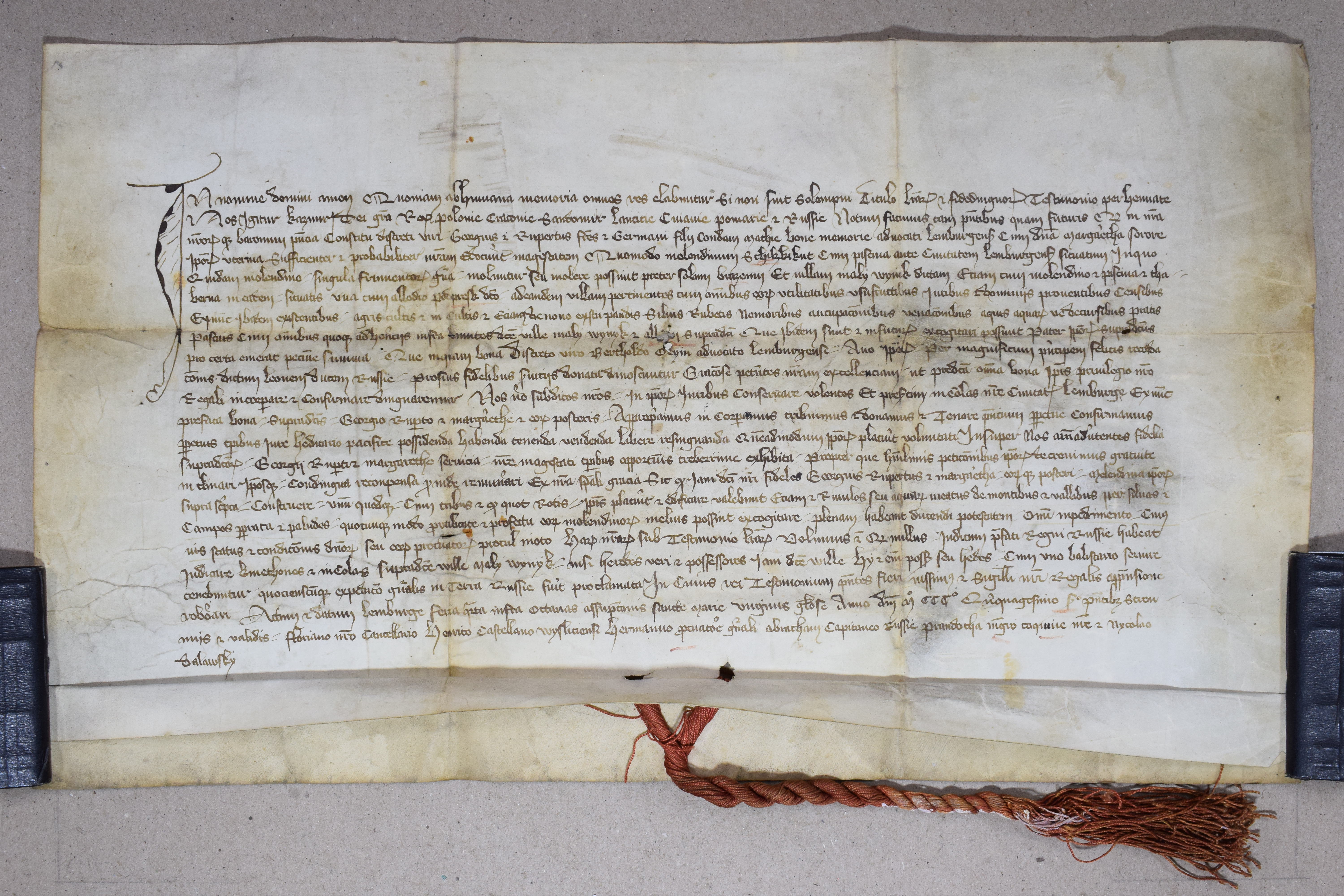
33. The original document is held in: Central State Historical Archive of Ukraine in Lviv (Tsentralnyi derzhavnyi istorychnyi arkhiv Ukrainy u Lvovi – TsDIAL), fonds 131, file 2.
34. [PL 41] See Town and Country Records from the times of the Republic of Poland from the so-called Bernardine Archive in Lviv (hereinafter: AGiZ), vol. II, ed. X. Liske, Lviv 1870, no. I, pp. 1–2..
35. If one were to assume that the calendar year was originally written in the manuscript using Roman numerals, its presumed reconstruction would require assuming that the text was supplemented or distorted by blurred, illegible, or deliberately erased trailing characters "L" and "II", which in its entirety would yield the notation M.CCC.LII (=1352).
36. Cf. S. Kętrzyński, O elementach chronologicznych dokumentów Kazimierza Wielkiego [On the Chronological Elements of Casimir the Great’s Documents], Kraków 1913, pp. 61–62 [137–138]. Available online via the Polona digital library: https://polona.pl; Ibidem, p. 62.
37. In St. Kętrzyński's notation: “feria IV infra Octavas assumpcionis sancte Marie virginis…” (p. 62 [138]).
38. Vide: pp. 6 [82] to 9 [85]—although, as the aforementioned St. Kętrzyński writes: “exceptionally, in the method of dating, we also encounter dating according to the Roman calendar system—which should be attributed (in his opinion) only (?) to the initial years of Casimir the Great’s reign, encompassing a total of 10 documents,” “of which two belong to the group of forgeries or suspect acts” (p. 10 [86]).
39. Ibidem [As above], cont.: Among the witnesses of the above document (from 1352?), Abraham appears as the starosta of Rus’; meanwhile, it is known that in September of that year, Otto of Pilcza held this office (Kw. hist. 1900, p. 54) and it is certain that he held it in the years 1350/51 (L. Ehrlich, Starostwa, p. 12). Another document in which Abraham appears as the starosta of Rus' from the year 1358 (X. S. Barącz, Tow. duch. kat., 486) is a forgery. Cf. K. Sochaniewicz, Herb Miasta Lwowa [The Coat of Arms of the City of Lviv], Lwów 1933, in footnote no. 10 to Chapter II, p. 73
40. The exact record of the act of transferring the village of Otwinów (Otwynow) to German law, issued by Casimir the Great in Szczebrzeszyn on August 23, 1352; see AGiZ, vol. V, ed. X. Liske, Lwów 1874, no. III, pp. 3–5.
41. See also: vide St. Kętrzyński..., p. 61.
42. S. Kętrzyński, O elementach chronologicznych... [On the Chronological Elements...], p. 61. Ibidem, p. 35, fn. 2: “The ruling of a document is a rather important criterion. All documents that issued from the chancery of Casimir the Great are ruled. In general, we know of five exceptions, including three forgeries.” The second material criterion for Kętrzyński was the triangular shape of the incision in the fold (plica) for the seal cord, which dominated in the chancery until 1360.
43. Kętrzyński’s analysis is based on the formula feria IV infra Octavas assumpcionis sancte Marie virginis... See ibidem, pp. 6–10 [82–86]. The author notes that, exceptionally, dating according to the Roman calendar system (Roman style) was used in the Casimirian chancery, which relates almost exclusively to the initial years of the monarch’s reign and encompasses a group of barely 10 documents, of which two constitute evident forgeries or highly suspect acts.
44. Bernardine Archive in Lviv] (hereinafter: AGiZ), vol. II, ed. X. Liske, Lwów 1870, no. I, pp. 1–3. AGiZ, vol. V, ed. X. Liske, Lwów 1874, no. III, pp. 3–4.
45. Assuming, for the purposes of comparative analysis, the methodological premise that X. Liske’s reading of the calendar year (1352) in the Lviv document was correct.
46. Szczebrzeszyn, situated on the Wieprz River, was at that time an important staging point on the route connecting Lesser Poland with Red Ruthenia.
47. The royal title used in the document of August 22 (?), 1352: “Kazimirus Dei gracia Rex Polonie, Cracovie, Sandomirie, Lancicie, Cuiavie, Pomarie (sic) et Russie Notum facimus tam presentibus quam futuris..”
48. The royal title in the document of 1356 ("King Casimir the Great grants the city of Lviv the German Magdeburg law, endowing it with 70 Franconian łans..."): “Kazimirus dei gi'acia Rex Polonie necnou Terrarum Cracouie, Saudomirie, Syradie, Cuyauie, Pomoranie Russieque dominus et heres..” (AGiZ, vol. III, doc. no. V, p. 13).
49. Cf. H. Paszkiewicz, Polityka ruska Kazimierza Wielkiego [The Rus' Policy of Casimir the Great], Warszawa 1925, p. 134, fn. 2.
50. Florian, royal chancellor (Floriano nostro Cancellario): Florian of Mokrsko (later Bishop of Kraków) became the Great Crown Chancellor only in the first half of 1355, following the death of the previous chancellor, Janusz. In August 1352, Florian did not yet hold this state dignity and had no right to sign royal documents as chancellor, which constitutes a glaring official anachronism of the Lviv act. Abraham, starosta of Rus’ (Abracham Capitaneo Russie): Abraham of Baranów held the office of the starosta of Rus' (Halych) in the years 1352–1356, which—with the forged calendar year of 1352—was intended to lend credibility to the witness structure.
51. See further on property registration and disputes over mills: R. Zubyk, Gospodarka finansowa miasta Lwowa w latach 1613–1640 [The Financial Economy of the City of Lviv in the Years 1613–1640], Lwów 1930 [here referring to the lustration and property inquiry from the beginning of the 17th century].
52. On the genesis of the founding legend and the involvement of Lviv intellectuals in creating the figure of Prince Lev for the needs of Western European geographical publications, see J. Alnpek, Topographia civitatis Leopolitanae..., pp. 12–15; B. Zimorowicz, Leopolis Triplex, passim.