
More Information
Submitted: August 20, 2026 | Accepted: August 29, 2026 | Published: August 31, 2026
Citation: Szymski AM. Lviv – The Zvenyhorod Heritage: Part III: The Birth of the “New” City Arch Case Rep. 2026; 10(8): 82-92. Available from:
https://dx.doi.org/10.29328/journal.acr.1001194
DOI: 10.29328/journal.acr.1001194
Copyright license: © 2026 Szymski AM. This is an open access article distributed under the Creative Commons Attribution License, which permits unrestricted use, distribution, and reproduction in any medium, provided the original work is properly cited.
Keywords: Lviv; Casimir III the Great; Lev Danylovych; Medieval diplomacy; Documentary criticism; Magdeburg law; Historical topography; Stecher family; Medieval forgery; Galicia-Volhynia

Lviv – The Zvenyhorod Heritage: Part III: The Birth of the “New” City
Adam M Szymski*
West Pomeranian University of Technology in Szczecin, Poland
*Corresponding author: Adam M Szymski, West Pomeranian University of Technology in Szczecin, Poland, Email: [email protected]
This article examines the historiographical and documentary evidence concerning the emergence of the so-called “new” city of Lviv and, in particular, the authenticity and chronological significance of a diploma attributed to King Casimir III the Great and traditionally dated to August 22, 1352. The study critically evaluates interpretations that use this document to argue for a pre-Casimirian municipal incorporation of Lviv during the reign of Prince Lev Danylovych. Particular attention is given to the identification of the advocate Berthold, the estates associated with the Stecher family, the toponym “Schilzkikut,” the chronological formula of the diploma, the royal itinerary, witness lists, royal titulature, and selected material features of the parchment. The analysis compares the disputed Lviv document with the authenticated diploma issued by Casimir III near Szczebrzeszyn on August 23, 1352, while also considering alternative explanations proposed in earlier scholarship, including the possibility of a two-stage chancery procedure or an earlier oral legal act followed by later formalization. The evidence discussed in the article raises substantial chronological, diplomatic, genealogical, and material questions concerning the traditional dating and authenticity of the Lviv document. The article argues that these issues should be evaluated through a distinction between directly attested evidence, historiographical interpretation, and hypotheses concerning the document’s production and subsequent use.
Introduction and historiographical context
The question of the emergence of the medieval urban structure of Lviv remains an important subject of historiographical debate. Particular disagreement concerns the chronological relationship between the princely settlement associated with Lev Danylovych and the later institutional reorganization of the city under Casimir III the Great. One line of interpretation associates elements of Lviv’s urban and legal organization with the late thirteenth century, whereas another emphasizes the institutional significance of the Casimirian incorporation of the city in the fourteenth century.
A central source in this debate is a diploma attributed to Casimir III and traditionally dated to August 22, 1352. The document refers to members of a family associated with Lviv, describes several properties, and mentions an earlier advocate named Berthold. Because the document has been used to support arguments concerning the existence of an organized urban community in Lviv before the Casimirian incorporation, its authenticity and chronology have consequences extending beyond the interpretation of a single documentary record.
Maryla Dolynska and other scholars have used the document in conjunction with historical-topographical and cartographic analysis to reconstruct aspects of Lviv’s earlier spatial development. Their interpretation deserves direct examination alongside the alternative arguments advanced by other historians, including J. Dyba, M. Kapral, A. Janeczek, S. Kętrzyński, H. Paszkiewicz and other scholars cited in the present study.
The principal objective of this article is therefore not simply to repeat the traditional debate concerning the date of Lviv’s incorporation, but to examine the documentary basis on which competing interpretations have been constructed. Particular attention is given to the internal structure of the 1352 diploma, its chronology, royal itinerary, witness list, titulature, material characteristics, and relationship to authenticated documents issued by Casimir III.
The analysis also distinguishes between observations that can be directly established from the documentary record and interpretations that remain hypothetical. This distinction is particularly important in evaluating the possibility that the disputed diploma represents an authentic document subsequently altered, a record based on an earlier oral legal act, or a later forgery incorporating genuine historical information.
The significance of maryla dolinska’s research in contemporary historiography of lviv: a critical analysis
For over two decades of the 21st century, a key theme in the historical policy of independent Ukraine has been the complete negation of Casimir III the Great’s organizational activities and their impact on the rapid civilizational development of the lands of the former Kingdom of Galicia–Volhynia (referred to in literature as Red Ruthenia) in the 14th century. These efforts frequently cross the boundaries of scholarly integrity regarding the objective verification and evaluation of the reliability of existing source documents. Alongside researchers such as R. Mohatycz, M. Kotlar, and J. Dyba [1,2], one of the pivotal figures denying these achievements has become Prof. Maryla Dolinska (Mar’yana Dolynska)[3]. She built her academic career primarily on the historiographical analysis of Lviv based on a method she terms “retrospective urbanism [4]. According to the author, this method—through the analysis of surviving maps of Lviv and its surroundings (dating from the late 18th and 19th centuries, back to the 17th century)—allegedly allows for the reconstruction of the spatial development of these areas during the reign of Lev Danylovych (†13011302), thereby projecting the urban structure [the image of the state of land development of Lviv and its surroundings] several centuries back into the past.
Dolinska’s primary achievement, accomplished by means of this uniquely constructed “time machine,” was “proving” that Lviv, as a fully formed European city, was not granted its charter of incorporation in the second half of the 14th century (as traditional historiography maintains), but already during the reign of the aforementioned Lev Danylovych in the Principality of Halych [in the years 1270–1301?]. The crowning proof and foundation for this formulated view—introduced into official academic circulation and backed by the authority of the National Academy of Sciences of Ukraine—became a document issued by Casimir the Great. King Casimir allegedly issued it on August 22, 1352, in Lviv, at the request of the grandsons of a former Lviv advocate (vogt) named Berthold (Bertholdo)[5]. For years, Ukrainian historical policy has aimed to demonstrate full civilizational continuity and to push the moment of Lviv’s incorporation as far back in time as possible into the pre-Polish period, whereas the actual organizational and urban leap of the city [in the belief of most Polish historians] is inextricably linked to the institutional [and organizational] initiative of Casimir III (the Great) from later years.
Professor Mariana Dolynska based her doctoral dissertation and subsequent academic career on an attempt to reconstruct the historical topography of Lviv using the regressive method. This procedure involves a hypothetical “backward movement in time” through the systematic comparison of the spatial layout captured on surviving cartographic plans—from the newest to the oldest. By extrapolating the evolutionary process observed in this manner, the author attempts to reconstruct the original urban layout. Based on this method and information drawn directly from the document issued by Casimir III the Great on August 22, 1352, the researcher formulated the thesis that the regular structure of Lviv (the so-called chartered city with its Market Square) was not laid out ex nihilo (“on raw roots”) during the Polish period. In her view, these outlines took shape as early as the last third of the 13th century under the influence of German settlers brought in by Prince Lev Danylovych, and she considers a German settler named Berthold, who lived in the suburbium at the time, to be the actual creator of the “new” city.
This stance meets with justified criticism within medieval studies. Even under the highly cautious assumption that an organized community of German merchants (centered around the Church of St. John the Baptist) already operated within the Lviv suburbium during the reign of Lev Danylovych, granting German law to a distinct nation or religious community is not equivalent to the incorporation of the entire city as a unified legal and institutional organism [6].
As researchers of the subject aptly point out, Prince Lev—similarly to what took place in Przemyśl—could have created merely an autonomous enclave for foreign merchants, without altering the fundamental structures of his own state [7].
The introduction of full Magdeburg Law as a universal municipal system would stand in stark contradiction to the jurisdictional monopoly of the “Russkaya Pravda” (Rus’ Justice). Furthermore, the primacy of the Catholic religion, formulated expressis verbis in Magdeburg Law, as well as the impossibility of immediately replacing the system of service obligations with a rent-based economic structure, completely ruled out any possibility of a conflict-free liquidation of the castle-territorial system in the Principality of Halych.
For this reason, the incorporation of a “new” city based strictly on the European model (with the primacy of the Catholic religion over other faiths of its inhabitants, and with autonomous prerogatives and self-government)—standing in natural opposition to unlimited princely power and the interests of the boyar elite—would directly imply the liquidation of the Principality of Halych in its existing legal framework, and consequently, the rejection of the entire cultural tradition of “Orthodox Rus’.” The best proof of this state of affairs is the fact that the attempt to incorporate Sanok, undertaken by Bolesław-Jerzy II Trojdenovych, became one of the direct causes of the ruler’s poisoning by the boyars—acting as an obvious defense of the existing castle-and-service order [along with the cultural tradition of Orthodoxy] [8].
Furthermore: The spatial dimension of incorporation was, by its very nature, holistic [and not, as the aforementioned Ukrainian historians seem to believe, “staged”]. It determined the demarcation of the incorporated territory within strictly defined boundaries, which was only then followed by the second stage: endowing the organism thus separated with the [additional] lands necessary for its economic functioning. In the light of source analysis, there is no doubt that a complete procedure of this type was only implemented by Casimir the Great. He laid out the new center of Lviv around the Market Square, ordered it to be enclosed with a moat and defensive walls, and only then provided the newly created city with a stable institutional order by granting Magdeburg Law in 1356, while also guaranteeing the material foundations of the burghers’ existence by endowing the city with 70 łans [mansi] of land.
Despite such clear institutional barriers, a contrasting stance is consistently promoted within Ukrainian scholarship, according to M. Dolinska, supported in this matter by J. Dyba and M. Kapral, the fact that Lev Danylovych allegedly granted the mythical Berthold an advocateship (vogtship) under German law implies the thesis that Lviv must have already possessed a developed municipal structure at that time. In their view, a specific affirmation of this state of affairs became the institution of the hereditary advocate, although—as is well known—it was entirely foreign to the system of Rus’ law. Nevertheless, in Ukrainian historiography, this thesis serves as a key argument for the view that in 1356, Casimir III the Great merely sanctioned and [only] extended the pre-existing legal status of a fully formed, European urban organism [11]. These actions fit into a broader trend of contemporary Ukrainian historical policy, which aims—by deprecating the civilizational significance of Polish rule [9] to create a pre-Polish founding myth of Lviv [10].
In this context, it becomes understandable why M. Dolinska’s use of Casimir the Great’s 1352 document, as supposedly authentic material evidence of the existence of the advocate Berthold during the times of Lev Danylovych, became a necessary condition for validating her hypothesis. Aside from the fact that nothing in the content of the said 1352 diploma indicates that this advocate bore the surname Stecher, Dolinska spent years of work trying to “resuscitate” this figure. The key to this operation was meant to be locating the mill allegedly granted to Berthold, recorded in the sources in the distorted form “Schilzkikut”[11].
Paradoxically, the philological exegesis of this document carried out by the researcher herself and her collaborators undermines its credibility, for instance, through a glaringly erroneous translation of the term specifying the equipment of one crossbowman (cum uno balistario) as using... a “quarry” or a medieval mortar, which represents a gross military anachronism for the middle of the 14th century. More importantly, the attempt to identify the “Schilzkikut” object with the mill of the Church of Our Lady of the Snows located in the Kraków Suburb ignores alternative toponomastic readings, which suggest a [supposedly] Slavic etymology of this name and a completely different topographic location [12]. Despite these evident methodological gaps, the mythical figure of the advocate Berthold as the founder of preCasimirian Lviv has even received a visual representation in a Lviv museum, functioning in the local discourse as a scientifically proven fact [13].
Analyzing the meaning of the name “Schilzkikut”—which appears nowhere else in existing documents from that era, nor in the inventory lists from the “Austrian period” of Lviv’s existence—M. Dolinska followed the version of the “translation” of this name into Ukrainian proposed by Antoni Petrushevych [14]. According to this version, the term was meant to describe not the proper name of the mill, but rather the location where it was situated. Considering his interpretation to be incorrect, she advanced her own hypothesis regarding the existence of the advocate Berthold’s mill at the “Village Bend” (Wiejskie Zakole). This was allegedly located on an artificial mill race of the Poltva River, at the spot where the modern administrative boundaries of Lviv (established as late as the 19th century) bent near Zamarstynivska (alias Mostova) [15].Road within the territory of the Kraków Suburb (Figure 1).
In support of this thesis, the researcher cited Austrian cadastral maps and Old Polish inventories, demonstrating that as late as the beginning of the 20th century, a modern steam mill and bakery belonging to Natan Mayer operated at that very location. When the remains of a former river mill were uncovered in the basements of this building in 2021, M. Dolinska immediately linked this discovery to the 13th-century advocate Berthold, which sparked a widely commented sensation in the Lviv media [16].
Consistently expanding this “reconstructed” map of alleged 13th-century Lviv, M. Dolinska attempted to locate the remaining estates mentioned in the 1352 diploma within the area of present-day Zamarstyniv [17]: the Podpresk grange and the settlement of Maly Vinik. The author deemed the traditional identification of the latter with the present-day town of Vynnyky to be entirely erroneous.
In her conviction, the name Maly Vinik did not signify a separate, distant locality at that time, but rather designated a suburban area of viticulture and gardens operating as a service settlement. The researcher supported her argument with a peculiar logistical assumption, according to which a 13th-century advocate of Lviv could not have traveled many kilometers on horseback each day through dense forests to oversee an estate located east of the city [18]. According to Dolinska, it was precisely these suburban lands—acquired in the 15th century by Jan Sommerstein—that gave rise to present-day Zamarstyniv (within the area of the so-called Belshchyna Belz Fields)[19]. With this a priori thesis, the researcher completely rejected the existing historiographical body of work (including, among others, the findings of Andriy Baytsar, which ironically cited earlier publications by M. Dolinska herself), which unequivocally links the oldest history of Vynnyky to the Marunka River basin [20].
Another hypothesis by Dolinska—which relocates not only the “Schilzkikut” mill but also the entire alleged estate of the advocate Berthold’s heirs from the lands along the Marunka River to the northern, marshy peripheries of Lviv—is supposedly confirmed by a document issued.
by Vladislaus II of Opole in 1378 [21]. From its content, as interpreted by the Ukrainian researcher, it would directly imply that the governor, at the request of Gregory Stecher, granted him (in exchange for scattered plots of land per iam dictam villam Maly Wynik) a contiguous complex of fields located between the branches of the Poltva River and on the plateau of a hill situated north of Stecher’s original estates (which Dolinska arbitrarily identifies with the area between present-day I. Mykolaychuk Street and Topolova Lane). This grant was meant to encompass as much area as the recipient could cultivate using five plows. Such an extrapolation of a modern street grid onto 14th-century topographic realities, however, constitutes a glaring example of source overinterpretation aimed at artificially anchoring the estate of Berthold (?) Stecher within the space of Lviv’s northern suburb, which M. Dolinska seems to associate with hamlets named “Volynya” and “Porichchya.” Her assertion that the “Pod Prieska Gorka” grange was not a part of the village of “Male Vynnyky” but quite the opposite—that “villa maly Vinnik” (in which phrase, according to M. Dolinska, the word “villa” is meant to signify not a “village” but a single house or homestead) was a PART of the “Podpr(i)esk” grange—can be considered downright absurd [22].
Nevertheless:
By shifting the location of the advocate Berthold’s estates from the Lviv forests to the territory of the “Belz Fields”—allegedly already partially settled in the second half of the 13th century—and placing “his” mill at the corner of present-day Zamarstynivska and Khemichna [Chemical] streets (which was meant to achieve the status of an indisputable fact thanks to the supposedly existing “archaeological evidence”28, M. Dolinska formulated the ultimate argument in favor of her main thesis. According to this narrative, since an advocate under German law already possessed an infrastructurally advanced mill in the very center of the princely suburbium back in the 13th century, then this entire suburbium must have possessed the character of a fully formed, Western European city. The introduction of this thesis into academic circulation was intended to be a discovery of near-epochal significance for the historiography of Lviv.
Thanks to this research construct, we are meant to learn not only that by granting Magdeburg rights in 1356, King Casimir III the Great merely carried out a secondary reception of law over an already existing municipal structure. What is most astonishing in this entire tale is that the regulated city “within the walls” was allegedly standing, completely formed, as early as the first Polish raid in 1340. This fact, however, would have had to go entirely unnoticed by all contemporary chroniclers, who unanimously omitted the existence of such a spectacular urban phenomenon in Rus’ in their accounts. It was also unnoticed by the author of the Galician–Volhynian Chronicle, despite its final entries ending in the year 1292, by which time the incorporation of the “new city” must have already taken place according to M. Dolinska’s hypothesis.
The document of casimir iii (the great) from 1352 [23]: genuine or forged?
Given the fact that the document of August 22 (?), 1352, remained completely unknown to the key early modern chroniclers and historians of Lviv—including Bartłomiej Zimorowicz, Jan Alnpek, and Tomasz Pirawski [24-26], its discovery by the Ukrainian historian Denys Zubrytskyi in the mid-1840s became an event of scholarly sensation. The first source edition was published by Ksawery Liske in 1870, in the second volume of Akta Grodzkie i Ziemskie [Castle and Land Records]. The weight of this discovery appears all the greater because, until that moment, knowledge about Lviv from the reign of Lev Danylovych rested almost exclusively on five brief mentions contained in the Galician–Volhynian Chronicle (discovered by Nikolay Karamzin in the 1830s).
The lack of critical commentary from Denys Zubrytskyi in his Chronicle of the City of Lviv [27], (published in Polish at his own expense in 1844)—a researcher otherwise known for his ruthless questioning of the authenticity of other Casimirian diplomas (including the acts of 1356 and 1368)—solidified the conviction in historiography regarding the absolute reliability of the 1352 document. The first significant reservations were raised only by Stanisław.
Kętrzyński [28], However, these were limited exclusively to the controversial chronological layer of the act, without a deeper analysis of the genealogical connections of the Stecher family to the issued privilege. Kętrzyński’s remarks, aside from the findings of Kazimierz Sochaniewicz [29], passed almost unnoticed in Lviv studies. A similar fate befell the critical and methodologically significant observations of Henryk Paszkiewicz [30], which did not receive even an attempt at substantive polemic in either Polish or, at that time, Russian-language medieval studies (Figure 2a).
The question of the document’s authenticity in its substantive and diplomatic layers was ignored by later researchers. This occurred despite the fact that a double-sided facsimile of the parchment was published by M. Dolinska in 2019 [31], and a digital reproduction of its obverse is widely available in the collections of the Lviv archive [32]. A critical analysis of this pivotal source, currently preserved in the Central State Historical Archive of Ukraine in Lviv [33], was also omitted from the lifework of the most esteemed scholar of Red Ruthenia’s settlement structures in contemporary Polish medieval studies—Prof. Andrzej Janeczek.
The structure of the 1352 document: personalia and the anatomy of the inherited estate
In the light of diplomatic analysis of the document dated August 22, 1352, the subject and object structure of the alleged grant presents itself as follows:
The very object structure of this estate in relation to geographical space is characterized by two fundamental anomalies that expose the artificiality of this record:
1. Trilingualism of nomenclature (Toponomastic hybrid): The individual component parts of the estate represent three different linguistic spheres. The name of the mill, “Schilzkikut,” exhibits an Old German provenance (a corrupted Silesian or Saxon dialect); the name of the village, “Maly Vinik” (Mały Winnik / Małe Winniki), is a toponym with an unequivocally Polish (not Rus’) phonetics; meanwhile, the name of the grange, “Podpresk” (Podpriesk / Podpriesk?), possesses an evident East Slavic (Rus’) etymology.
Descriptive and topographic asymmetry: There is a glaring disproportion in the manner of describing the individual estates. The location of the village of Maly Vinik and the Podpresk grange was treated as obvious and requiring no detailed specification of boundaries. Quite the contrary is true for the “Schilzkikut” mill along with its appurtenant pond—its positioning required the issuer to introduce a precise locational descriptor (ante civitatem – before/outside the city). Furthermore, a production profile was restrictively defined solely for this one facility, introducing an absolute prohibition on grinding brewing malt therein, whereas the second mill (situated in the village) was treated purely enunciatively and sketchily..
The eschatocol of the document and the problem of chronology and the monarch’s itinerary
The original text of the document (Figure 2a) concludes with an eschatocol formula typical of 14th-century diplomas, containing the annual, monthly, and daily dating, as well as a list of witnesses (testes) intended to validate the monarch’s legal act:
“...Actum et datum Lemburge feria quarta infra Octavas assumpcionis sancte Marie virginis gloriose Anno domini M. CCC.... Quinquagesimo s.., presentibus strenuis et validis floriano nostro Cancellario, Henrico Castellano Wysliciensi, Hermanno procuratore generali, abracham Capitaneo Russie, Prandotha magistro coquine nostre et Nycolao Dalawsky.”
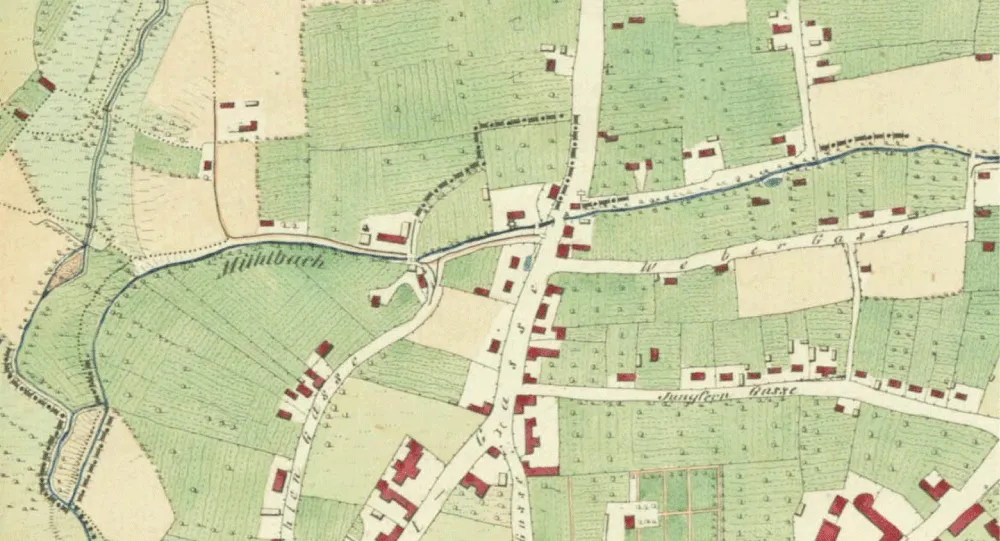
Figure 1: The “Country Corner” (also known as Сільській кут = “Schilzkikut”) with a backhoe mill (?) discovered by M. Dolynska on the Młynówka (Muhlbach) canal on a map of Lviv from 1844.
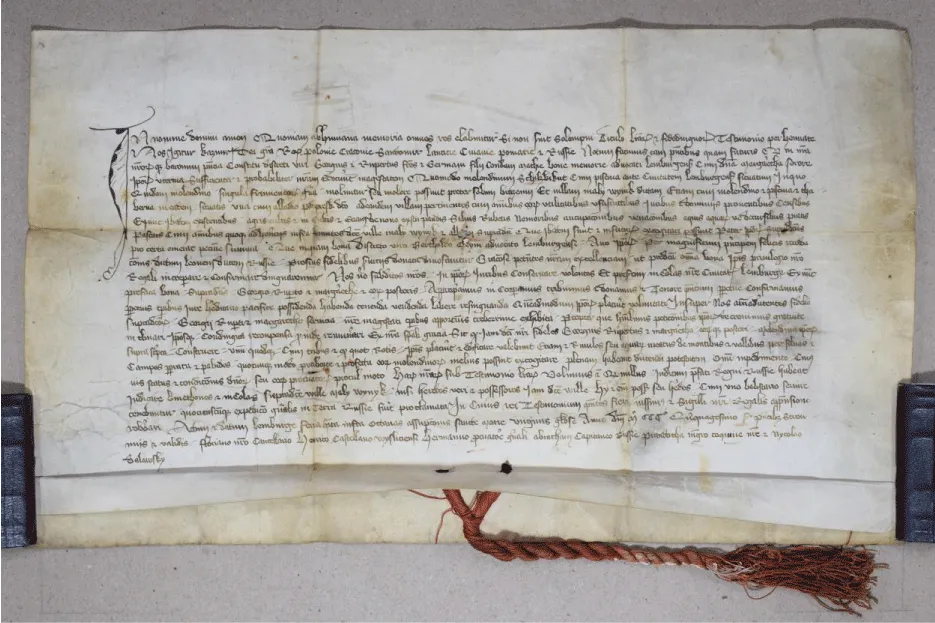
Figure 2a: The original document of K. the Great from 1352, currently kept in the Central State Historical Archives of Ukraine in Lviv.
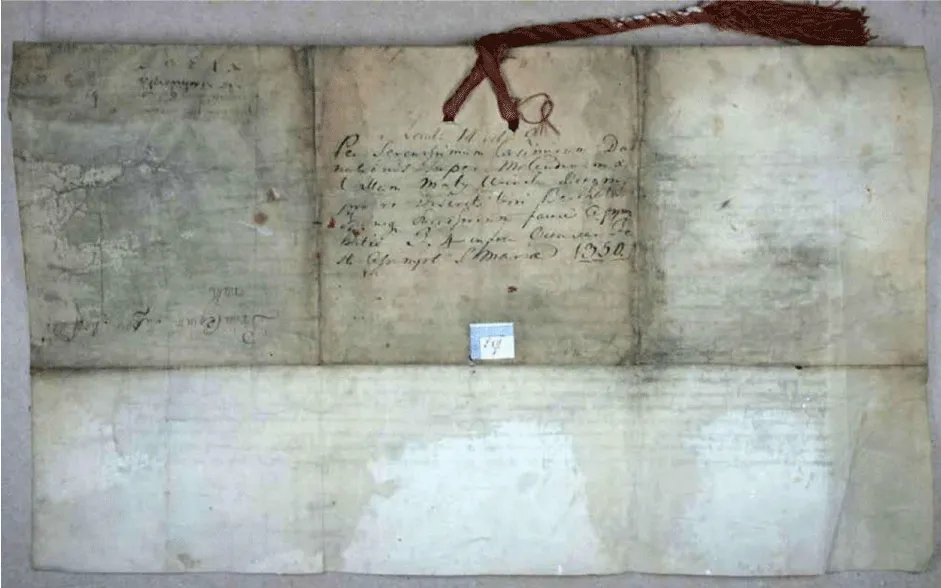
Figure 2b: The back side of the original document preserved in the Central Historical Archives of Ukraine in Lviv, according to a reproduction from the publication by M. Dolynska (see footnote no. 38).
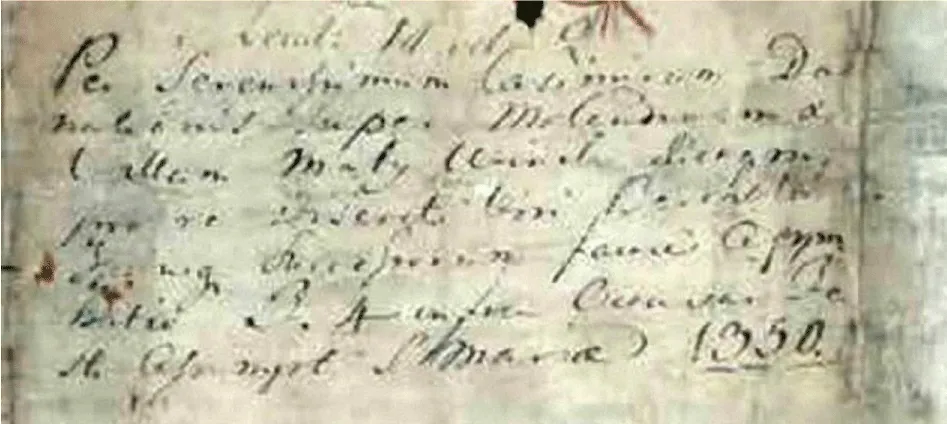
Figure 2c: Preserved text on the reverse side of the original document with comments by St. Kętrzyński.
Figure 2d,e: The next two texts from the back of the original document (as above) with the legible word “stachiroschi” (?).
This text, reconstructed in its full wording and published for the first time by Ksawery Liske [34], contains a pivotal anomaly in the notation of the calendar year. The editor, having encountered the letter “s” ending an incomplete word in the manuscript, carried out an editorial and highly conjectural reconstruction of the abbreviation, expanding it to the form “s[ecundo]”, which resulted in the year 1352 commonly accepted in the literature (Figure 3).

Figure 3: Fragment of the digital (M.CCC.) and literal record from the photocopy of the original document with a marked (in a frame) sign read as the letter “S” (or F?) in Latin with a clear difference in the color (hue) of the pigment used [35].
This notation became one of the most controversial issues in Polish medieval diplomatics following the 1913 publication of Stanisław Kętrzyński’s fundamental study dedicated to the chronological elements of Casimir III the Great’s documents [36]. The detailed analysis of the indiction and calendar calculations conducted by Kętrzyński revealed a glaring error in Liske’s reading. The daily formula “feria quarta infra Octavas assumpcionis sancte Marie virginis” [37]. (Wednesday within the octave of the Assumption of the Blessed Virgin Mary), when cross-referenced with the Kraków calendar [38], does not correspond to the layout of the days of the week for the year 1352. In fact, in 1352, the feast of the Assumption itself (August 15) fell on a Wednesday (feria quarta), meaning that a “Wednesday within the octave” could not have occurred at all.S. Kętrzyński’s exact calculations indicate that the specified calendar layout corresponds exclusively to the year 1350. However, wishing to avoid outright disqualification of the authenticity of the entire diploma, S.Kętrzyński put forward a compromise hypothesis of a so-called two-stage chancery procedure: the oral legal act was to have taken place in Lviv on August 18, 1350, whereas its formal drafting and dispatch were allegedly not carried out until August 22, 1352.
This construct collapses, however, when confronted with the historical criticism and analysis of the royal itinerary carried out by Henryk Paszkiewicz [46]. This researcher demonstrated that Casimir the Great’s alleged stay in Lviv in August 1352 is a historical fiction. Indeed, the very next day—August 23, 1352—the king appears as the issuer of a document in Szczebrzeszyn (where he transferred the village of Otwinów to German law), located approximately 115 kilometers away. Moving the monarch along with his entire official apparatus (the chancery) and the court entourage over such a distance within a single day was physically impossible in the realities of the 14th century. Furthermore, Paszkiewicz pointed out a complete discrepancy in the personnel composition of the witnesses [38]: the dignitaries attesting the Lviv act (including Florian as chancellor and Henryk as the castellan of Wiślica) do not appear at all in the Szczebrzeszyn act of August 23 [40,41]. The presence of Abraham as the alleged starosta of Rus’ (Capitaneus Russie) also constitutes a major anachronism. As sources prove, Abraham held this office in the years 1350–1351, whereas in August and September 1352, the starosta of Rus’ was undoubtedly already Otto of Pilcza.
To the list of these striking substantive and chronological contradictions, one must add the complete lack of any information regarding the physical features of the parchment, in particular, the traces of ruling [42]. S.Kętrzyński unequivocally demonstrated that intact ruling marks were an ironclad rule in all authentic documents issuing from the chancery of Casimir the Great, and the few exceptions (barely five known cases) mostly concerned unquestionable forgeries [43]. A similar case applies to the technique of cutting the parchment fold (plica) for the seal cord—triangular incisions dominated the royal chancery comprehensively until 1360. The failure of contemporary Ukrainian researchers to verify these material criteria against the 1352 original allows them to uncritically utilize this deeply flawed document as a supposed pillar of the 13th-century incorporation of Lviv.
Comparative diplomatics: a critical juxtaposition of the acts of august 22 and 23, 1352 [44,45]
The ultimate verification of the authenticity of the Lviv document is made possible by the comparative method, which involves confronting its chancery parameters with an indisputably authentic diploma of Casimir III the Great, issued a mere day later. The object of this juxtaposition is the act issued on August 23, 1352, near Szczebrzeszyn, by virtue of which the monarch transferred the village of Otwinów from Polish law to Środa law (AGiZ, vol. V, no. III, pp. 3–4).
1. Critical transcription of eschatocols and intitulations
• The Lviv document (August 22, 1352 [?], AGiZ, vol. II, no. I, pp. 1–3):
- Intitulation: „Nos igitur Kazimirus Dei gracia Rex Polonie, Cracovie, Sandomirie, Lancicie, Cuiavie, Pomarie [sic!] et Russie...”
- Eschatocol: „Actum et datum Lemburge feria quarta infra Octavas assumpcionis sancte Marie virginis gloriose Anno domini M. CCC. Quinquagesimo s[ecundo], presentibus strenuis et validis floriano nostro Cancellario, Henrico Castellano Wysliciensi, Hermanno procuratore generali, abracham Capitaneo Russie, Prandotha magistro coquine nostre et Nycolao Dalawsky.”
• The Szczebrzeszyn document (August 23, 1352, AGiZ, vol. V, no. III, pp. 3–4):
- Intitulation: Kazimirus Dei gracia Rex Polonie nec non terrarum Cracouie, Sandomirie, Syriade, Lancicie, Cuyauie, Pomeranieque dominus et heres...
- Eschatocol: Actum prope Szczebressyno opido ruthenicali in villa beati Bartholomei apostoli anno domini millesimo CCC quinquagesimo secundo; presentibus hys testibus Iohanne Iura Palatino Sandomiriensi, Ewstachio Lublinensi, Iohanne Woyniciensi Castellanis, Petro Tribuno Cracouiensi, Czanssa de Cowale, Stanislao de Mokresco heredibus et aliis pluribus fide dignis.
2. Comparative analysis of chancery parameters
A juxtaposition of the formal and substantive features of both documents reveals a series of fundamental contradictions that exclude the authenticity of the Lviv act within the context of the year 1352:
Document The Szczebrzeszyn Document| The Szczebrzeszyn Document | |
| Feature | The Lviv Document (Forgery?) (Authentic) |
| Daily and annual date | Wednesday within the octave of the The Eve of St. Bartholomew the Apostle Assumption of the BVM → August → August 23, 1352 22, 1352 (Liske's reading) |
| Place of issuance | Near Szczebrzeszyn (prope Lviv (Lemburge) Szczebressyno) |
| Royal intitulation | Rex Polonie (...) et Russie (Royal Rex Polonie (...) dominus et heres title for Rus') (Proprietorship-hereditary formula) |
| Officials and dignitaries strictly The official elite of Lesser Poland (the Witness list connected with Rus' (Chancellor Palatine of Sandomierz, the castellans of (testes) Florian, Starosta Abraham). Lublin and Wojnicz). |
|
3. Critical evaluation and diplomatic anomalies
An analysis of the aforementioned data allows for the formulation of two decisive arguments that disqualify the Lviv document as a 14th-century authentic act:
A. Physical and logistical contradiction (The Itinerary)
The road distance between Lviv and Szczebrzeszyn (situated on the Wieprz River) [40] is approximately 115 kilometers in a straight line, which in the realities of the 14th-century road network meant a distance significantly longer and more difficult to traverse. A medieval royal entourage, traveling alongside the entire official structure of the state chancery, standardly covered a maximum distance of 20–30 kilometers per day. The hypothesis according to which King Casimir III the Great personally issued a privilege in Lviv on August 22 and signed another document near Szczebrzeszyn as early as August 23 is completely ruled out from a physical and logistical point of view. Moving the monarch’s court over this distance in less than 24 hours was unfeasible at the time.
B. Institutional anachronism of the royal intitulation
The intitulation formula used in the Szczebrzeszyn document (the Authentic act) fully complies with the strictures of the official Casimirian titles of that period. In it, the king lists the core Polish lands, concluding the phrase with the hereditary formula dominus et heres (lord and heir). It lacks a direct title of “King of Rus’” (Rex Russie), as the legal and political status of these lands in 1352 was highly unstable and in a phase of armed conquest. In this light, the intitulation from the Lviv document: Rex Polonie (...) et Russie constitutes a glaring, textbook anachronism [47]. Casimir the Great never used an official royal title in relation to Rus’ within such a formulated, permanent intitulation of his documents from this period [48]. The appearance of this formula is an evident trace of later chancery practice from the 15th century, or an intentional act of forgery aimed at artificially elevating the legal status of Lviv and legitimizing the privileges of its elites.
C. The dichotomy of the witness lists (Chancery logic)
These documents exhibit completely different witness lists. Had the king truly undertaken such a spectacular, express journey from Lviv to the PodlachiaLublin region, the same permanent group of officials making up the monarch’s close court entourage (comitatus) would have had to appear in both acts. The presence of an entirely new group of Lesser Polish magnates in the Szczebrzeszyn document (including Jan Jura, the Palatine of Sandomierz, and Jan, the castellan of Wojnicz) definitively proves that the king could not have been in the heart of Rus’ just a day prior, surrounded by the local starosta Abraham—whose presence is, moreover, already questioned by historical criticism [49].
Conclusion regarding the Lviv diploma (Forgery): The Lviv document with the alleged date of August 22, 1352, must be considered an indisputable forgery. An examination of the graphical and paleographical structure of the parchment proves that we are dealing with a fabricated document in which the calendar year was intentionally left underdetermined (not fully written out). This manipulation was meant to leave whoever evaluated the document solely on the basis of its substantive content (the figure of the advocate Berthold and his estate) with a safe, plausible “time window” between 1349 and 1353—the latter year being widely accepted in the literature as the date of the total destruction of fortified Lviv by Lithuanian forces under the command of Prince Dmytro Liubart.
Conversely, the attempt to hypothetically shift the date of issuance of this document to August 17, 1356 (two months after the official incorporation of Lviv)—although it would formally eliminate the anachronism of some of the witnesses [50] leads to the unmasking of the actual beneficiary of the original mystification, who was Gregory (Georgius) Stecher. It was he who, by invoking the alleged rights of his ancestors, secured the legal existence of his mill alone during the re-grant of 100 łans to the city in 1368, and carried out a lucrative exchange of scattered plots of land in Vynnyky for a contiguous field complex in 1378 (AGiZ, vol. III, no. XXV).
Among all analyzed hypotheses, the final formulation and execution of this forgery must most likely be placed at the turn of the 16th and 17th centuries. The impulse for this was the first comprehensive property lustration (inventory) of the cathedral chapter in 1608 (see the rigorous findings of Roman Zubyk) [51]. During this process, an attempt was made to accurately register and demarcate the number of mills in the Lviv estate complex at the time (divided into royal, ecclesiastical, and municipal). The existence of such a document was intended to directly attest that the estates acquired by the Church from the Stechers in the 14th century possessed solid, indisputable legal foundations derived from ancient inheritance. The content of this supposedly medieval privilege was intentionally tailored to the Renaissance-Baroque fashion and legend emerging in Lviv at the time regarding Prince Lev Danylovych as the primary, mythical founder of the city (mentioned, among others, by B. Zimorowicz and J. Alnpek for the purposes of Braun and Hogenberg’s global town atlas). The need to possess an “ancient, legendary creator”—typical for European cities of that era [52]—served as an ideal ideological matrix in which the forger clothed the property interests of the cathedral chapter.
The 17th-century forger cleverly wove this widely accepted mythology into the fabricated document of Casimir the Great, making the Polish king invoke the ancient grants of Prince Lev to a post hoc invented advocate Berthold. In 1352 (barely 12 years after the Poles’ first entry into Lviv), the authentic royal chancery used a completely different legal language and did not legitimize the grants of Rus’ rulers in such a sentimental manner. However, in 1608, to people living by the new mythology of Lviv, it sounded extraordinarily authentic. The analyzed document is a classic “false safe-conduct” [spurious title] manufactured for the purposes of property disputes and tax evasion. The author of the early modern note on the reverse of the parchment, by providing the arbitrary date of 1352, merely highlighted the fact of this forgery—for he had no knowledge of the king’s actual itinerary, which centuries later, for the year 1352, would be physically ruled out by H. Paszkiewicz.
Conclusion regarding the Szczebrzeszyn diploma (Authentic): The Szczebrzeszyn document of August 23, 1352, is an indisputable authentic act. Beyond its pivotal role in dismantling the chronology of the Lviv act, this diploma possesses autonomous scholarly value—it constitutes the oldest, reliable source mention of Szczebrzeszyn, defined explicitly as a functioning fortified stronghold or Rus’ town (opido ruthenicali). This document flawlessly attests to the actual presence of Casimir III the Great on the Lesser Poland–Rus’ borderlands during the summer military campaigns or the administrative tour of the Kingdom in 1352.
Alternative conclusion (The paradox of intentionality): It must be considered a peculiar methodological paradox that any potential attempt to defend the Lviv document by resorting to the theory of a mere clerical error (suggested by the early modern notes on the dorsereverse of the parchment) yields the opposite of the intended effect. The accumulation of so many contradictory data—from institutional anachronisms to physically impossible territorial shifts of the court—within a single act rules out the hypothesis of an accidental mistake by a scribe. The uncovered structure of calendar and substantive errors uniquely demonstrates the intentional, deliberate fabrication of legal reality by an early modern forger.
Only a total disregard for the suggestions contained directly in the early modern notes on the dorse (reverse) of the parchment in question, as well as ignoring the fact that this document— until its 19th-century discovery—reposed in the Archive of the Cathedral Chapter (as an instrument of defense for the clergy’s property rights), could lead to the formulation of an alternative hypothesis. Rejecting for a moment the dating of August 22, 1352, which is universally accepted in historiography, it must be pointed out that there are only two— mutually exclusive—possibilities in which the alleged Casimirian privilege from the mid-14th century could be considered an authentic diploma:
- Mohytych R, Planuvalna struktura lvivskoho seredmistia i problemy yoho datuvannia [The Planning Structure of Lviv’s City Center and the Problems of Its Dating], „Zapysky NTSH”, Vol. 227: Praci sekcii mystectvoznavstva, Lviv 1994, pp. 279–288; ejusdem, Rozvytok urbanistychnoho seredovyshcha Lvivskoho seredmistia u druhiy polovyni 13 – na pochatku 20 st. [Development of the Urban Environment of Lviv’s City Center from the Second Half of the 13th to the Beginning of the 20th Century], Avtoref. dys. kand. arh., Lviv: NULP, 2003.
- Yu. Dyba, V. Petryk, Planuvalna struktura “dolokaciynoho” Lvova [The Planning Structure of “Preincorporation” Lviv], [in:] Seminiariy “Kniazhi chasy”, Lviv: Manuskrypt, 2002, pp. 40–59.
- Academic profile of Prof. Mar’yana (Maryla) Dolynska on the Ukrainian Catholic University portal: https://humaniora.ucu.edu.ua/personal/mar-yana-dolynska / (accessed: July 28, 2026)
- Polish historians and architects consistently point to the methodological weakness of the regressive method when used in isolation from other disciplines: projecting early modern plans (including Austrian maps from the late 18th century) onto 13th- and 14th-century realities is highly unreliable and—lacking solid archaeological verification—prone to overinterpretations conditioned by the current ideological or political-historical context.
- According to M. Dolynska, it follows from this document, containing the monarch's confirmation of the rights of the advocate Berthold's grandsons to possess a specified estate (a mill, a grange, and a village with a mill and an inn), that the said ancestor received these properties from Prince Lev Danylovych as the acting advocate of Lviv ruling under German law (ius teutonicum). The author considers this proof that at the close of the 13th century, Lviv possessed a developed municipal structure and the institution of an advocate under Magdeburg law.
- See further: A. Janeczek, Spis urzędników, książka zażaleń. Z powodu pracy Myrona Kaprala, Urzędnicy miasta Lwowa w XIII–XVIII w. [A List of Officials, a Book of Grievances. On the Occasion of Myron Kapral's Work, Officials of the City of Lviv in the 13th–18th Centuries], (Spisy urzędników miejskich z obszaru dawnej
- Cf. ibidem, p. 178, where the Przemyśl analogy is pointed out, as well as the restriction of the jurisdiction of German law exclusively to the framework of a specific foreign colony.
- The charter of incorporation for Sanok under Magdeburg law was issued by Bolesław-Jerzy II on January 20, 1339. Barely fourteen months later, on April 7, 1340 (erroneously cited as March 21 in older literature), the king was poisoned in Volodymyr by conspiring boyars led by Dmytro Detko, which initiated the long-standing war over the Galician–Volhynian succession.
- Defined explicitly as “the beginning of the occupation period that lasted over 400 years” of the lands of "Western Ukraine" (!).
- An expression of this trend in the public sphere can be found in the author's own appearances; see, e.g., the broadcast featuring Prof. M. Dolynska: Polski mify pro istoriyu Lwowa, yakym bulo misto za knyazhykh chasiv [Polish Myths about the History of Lviv: What the City Was Like in the Princely Era], the "Bez bromu" project, available online: https://www.youtube.com/watch?v=SCmA80BlYrM .
- Akta Grodzkie i Ziemskie z czasów Rzeczypospolitej Polskiej z Archiwum tzw. Bernardyńskiego we Lwowie [Castle and Land Records from the Times of the Polish Commonwealth from the So-called Bernardine Archive in Lviv] (hereinafter: AGiZ), vol. II, Lviv 1870, no. I, p. 1: “Quomodo molendinum Schilzkikut cum piscina ante civitatem Lemburgensem situatam...”.
- Already Antoni Petrushevych, in his editorial commentary to AGiZ, was the first to suggest that the distorted term "Schilzkikut" should be read in a Rus' manner as "Selsky-kut" (Сільський кут), meaning "Village Corner/Bend." This shifts the interpretation of this name in the corrupted German language—characteristic of colonists originating from Lower Silesia—toward native (drawn from the Rus' language) toponymy; cf. AGiZ, vol. II, p. 2, fn. 1.
- His alleged figure as a locator (read: founder of the city) is on display at the Lviv History Museum (the Black House, 4 Rynok Square)—its very presence confirming M. Dolynska's hypotheses derived from discoveries that are downright impossible to prove [but have nevertheless been accepted within Ukrainian scholarship as scientifically confirmed FACTS].
- K. Liske, Akta Grodzkie i Ziemskie z czasów Rzeczypospolitej Polskiej z Archiwum tzw. Bernardyńskiego we Lwowie [Castle and Land Records from the Times of the Polish Commonwealth from the So-called Bernardine Archive in Lviv] (hereinafter: AGiZ), vol. II, Lviv 1870, no. I, pp. 1–2 (with commentary by A. Petrushevych, fn. 1 on p. 2, pointing to the Rus' etymology Selsky-kut).
- M. Dolynska, Istorychna topohrafiia Lvova XIV–XIX st. [Historical Topography of Lviv in the 14th–19th Centuries], Lviv 2006, pp. 218–220; see also: Atlas ukrainskykh istorychnykh mist [Atlas of Ukrainian
- See the media reports: U Lvovi v pidvali avariynoho budynku znaishly reshtky mlyna chasiv zasnovnyka mista [In Lviv, the Remains of a Mill from the Era of the City’s Founder Were Found in the Basement of an Endangered Building], "Lokalna Istoriya" portal, October 25, 2021, available online: https://localhistory.org.ua/news/u-lvovi-v-pidvali-avariinogo-budinku-znaishli-reshtki-mlina-chasiv-zasnovnikamista /
- In 1387 (or 1389, according to other sources), the Lviv burgher Johann Sommerstein received land from the city to establish a manor [grange?]. The name Sommersteinhof later transformed into Zamarstyniv (the boundary between Lviv and the estate ran along present-day Khemichna and Dashkevycha streets); it is mentioned under the name of "Belz Fields" (Belshchyna) as early as the first chronicle mention of Lviv. Cf. Wikipedia entry for Zamarstyniv: Замарстынов —Википедия
- Interview with Prof. M. Dolinska in the "Bez bromu" project (https://youtube.com). . The author asserts there that the identification of the estate to the south-east of Lviv is a logical error due to the distance and difficult terrain conditions in the 13th century.
- The distinct status of Sommerstein’s estate (Sommersteinhof) was regulated at the end of the 14th century, and the subsequent border with the city ran along present-day Khemichna and Dashkevycha streets. This area, formerly referred to as the “Belz Fields” (Belshchyna), already appears in the oldest chronicle mentions [vide fn. 22].
- Cf. A. Baytsar, Vynnyky davni i suchasni: Istoryko-krayeznavchyi narys [Vynnyky Ancient and Modern: A Historical-Local History Outline], Lviv 2012; idem, Istoriya Vynnyk v osobah [The History of Vynnyky in Personalities], Vynnyky 2017.
- The document of Vladislaus II of Opole, issued in Lviv on October 1, 1378; see AGiZ, vol. III, no. XXV, pp. 42–43.
- M. Dolynska, Nerukhomist' nimec'koji rodyny Shtekheriv v piznoserednovichnomu L'vovi: tradycijnyj ta interdyscyplynovyj pohliad [The Real Estate of the German Stecher Family in Late Medieval Lviv: A Traditional and Interdisciplinary View], [in:] Fenomen mul'tykul'turnosti v istoriji Ukrajiny i Pol'shchi. Materialy mizhnarodnoji naukovoji konferenciji, Kharkiv 2016, pp. 61–66 (especially pp. 64–65); eadem, Pochatky prostorovoji lokaciji L'vova v ostannij tretyni XIII stolittia [The Beginnings of the Spatial Incorporation of Lviv in the Last Third of the 13th Century], „Misto: istoria, kul'tura, suspil'stvo”, no. 6 (1), 2019, pp. 39–46 28 / Cf. footnote no. 21.
- Published in its entirety for the first time in 1870 in AGiZ, volume II, doc. 1, pp. 1–3; also in, among others: Oleh Kupchynskyi, Akty ta dokumenty Halycko-Volynskoho kniazivstva XIII — pershoi polovyny XIV stolit: doslidzhennia, teksty [Acts and Documents of the Galician–Volhynian Principality of the 13th – First Half of the 14th Centuries: Research, Texts], Lviv 2004, No. 9, pp. 773–776.
- B. Zimorowicz, Potriynyi Lviv / Leopolis Triplex [Triple Lviv], trans. from Latin by N. Careva, Lviv 2002.
- J. Alnpek (Alembek, Alnpekius), Topographia civitatis Leopolitanae... [Topography of the City of Lviv...], [in:] S. Rachwał, Jan Alnpek i jego „Opis miasta Lwowa” z początku XVII w. [Jan Alnpek and His "Description of the City of Lviv" from the Beginning of the 17th Century], Lviv 1930.
- T. Pirawski, Relatio status Almae Archidioecesis Leopoliensis [Account of the State of the Holy Archdiocese of Lviv], ed. C. Heck, Lviv 1893.
- D. Zubrzycki, Kronika miasta Lwowa [Chronicle of the City of Lviv], Lviv 1844.
- S. Kętrzyński, O elementach chronologicznych dokumentów Kazimierza Wielkiego [On the Chronological Elements of Casimir the Great’s Documents], Kraków 1913, pp. 132–133. Characteristically, this researcher considered another document published in the second volume of AGiZ (designated as No. II, an alleged 1359 privilege which was supposed to bear the oldest surviving seal of the Lviv municipal council) to be an absolute forgery.
- K. Sochaniewicz, Herb miasta Lwowa [The Coat of Arms of the City of Lviv], Lviv 1933, Chapter II along with footnotes. Sochaniewicz's findings regarding the inauthenticity of the seal attached to the 1359 document were also ignored in subsequent scholarly discourse.
- H. Paszkiewicz, Polityka ruska Kazimierza Wielkiego [The Rus' Policy of Casimir the Great], Warszawa 1925, p. 134, fn. 2.
- M. Dolynska, Pochatky prostorovoji lokaciji L'vova v ostannij tretyni XIII stolittia [The Beginnings of the Spatial Incorporation of Lviv in the Last Third of the 13th Century], „Misto: istoria, kul'tura, suspil'stvo”, no. 6 (1), Kyiv 2019, p. 42 (therein a reproduction of the obverse and reverse of the document)
- See the official portal of the Central State Historical Archive of Ukraine in Lviv (TsDIAL): https://tsdial.archives.gov.ua/images/exhib58/01.jpg (digital reproduction of the obverse).
- The original document is held in: Central State Historical Archive of Ukraine in Lviv (Tsentralnyi derzhavnyi istorychnyi arkhiv Ukrainy u Lvovi – TsDIAL), fonds 131, file 2.
- [PL 41] See Town and Country Records from the times of the Republic of Poland from the so-called Bernardine Archive in Lviv (hereinafter: AGiZ), vol. II, ed. X. Liske, Lviv 1870, no. I, pp. 1–2..
- If one were to assume that the calendar year was originally written in the manuscript using Roman numerals, its presumed reconstruction would require assuming that the text was supplemented or distorted by blurred, illegible, or deliberately erased trailing characters "L" and "II", which in its entirety would yield the notation M.CCC.LII (=1352).
- Cf. S. Kętrzyński, O elementach chronologicznych dokumentów Kazimierza Wielkiego [On the Chronological Elements of Casimir the Great’s Documents], Kraków 1913, pp. 61–62 [137–138]. Available online via the Polona digital library: https://polona.pl; Ibidem, p. 62.
- In St. Kętrzyński's notation: “feria IV infra Octavas assumpcionis sancte Marie virginis…” (p. 62 [138]).
- Vide: pp. 6 [82] to 9 [85]—although, as the aforementioned St. Kętrzyński writes: “exceptionally, in the method of dating, we also encounter dating according to the Roman calendar system—which should be attributed (in his opinion) only (?) to the initial years of Casimir the Great’s reign, encompassing a total of 10 documents,” “of which two belong to the group of forgeries or suspect acts” (p. 10 [86]).
- Ibidem [As above], cont.: Among the witnesses of the above document (from 1352?), Abraham appears as the starosta of Rus’; meanwhile, it is known that in September of that year, Otto of Pilcza held this office (Kw. hist. 1900, p. 54) and it is certain that he held it in the years 1350/51 (L. Ehrlich, Starostwa, p. 12). Another document in which Abraham appears as the starosta of Rus' from the year 1358 (X. S. Barącz, Tow. duch. kat., 486) is a forgery. Cf. K. Sochaniewicz, Herb Miasta Lwowa [The Coat of Arms of the City of Lviv], Lwów 1933, in footnote no. 10 to Chapter II, p. 73
- The exact record of the act of transferring the village of Otwinów (Otwynow) to German law, issued by Casimir the Great in Szczebrzeszyn on August 23, 1352; see AGiZ, vol. V, ed. X. Liske, Lwów 1874, no. III, pp. 3–5.
- See also: vide St. Kętrzyński..., p. 61.
- S. Kętrzyński, O elementach chronologicznych... [On the Chronological Elements...], p. 61. Ibidem, p. 35, fn. 2: “The ruling of a document is a rather important criterion. All documents that issued from the chancery of Casimir the Great are ruled. In general, we know of five exceptions, including three forgeries.” The second material criterion for Kętrzyński was the triangular shape of the incision in the fold (plica) for the seal cord, which dominated in the chancery until 1360.
- Kętrzyński’s analysis is based on the formula feria IV infra Octavas assumpcionis sancte Marie virginis... See ibidem, pp. 6–10 [82–86]. The author notes that, exceptionally, dating according to the Roman calendar system (Roman style) was used in the Casimirian chancery, which relates almost exclusively to the initial years of the monarch’s reign and encompasses a group of barely 10 documents, of which two constitute evident forgeries or highly suspect acts.
- Bernardine Archive in Lviv] (hereinafter: AGiZ), vol. II, ed. X. Liske, Lwów 1870, no. I, pp. 1–3. AGiZ, vol. V, ed. X. Liske, Lwów 1874, no. III, pp. 3–4.
- Assuming, for the purposes of comparative analysis, the methodological premise that X. Liske’s reading of the calendar year (1352) in the Lviv document was correct.
- Szczebrzeszyn, situated on the Wieprz River, was at that time an important staging point on the route connecting Lesser Poland with Red Ruthenia.
- The royal title used in the document of August 22 (?), 1352: “Kazimirus Dei gracia Rex Polonie, Cracovie, Sandomirie, Lancicie, Cuiavie, Pomarie (sic) et Russie Notum facimus tam presentibus quam futuris..”
- The royal title in the document of 1356 ("King Casimir the Great grants the city of Lviv the German Magdeburg law, endowing it with 70 Franconian łans..."): “Kazimirus dei gi'acia Rex Polonie necnou Terrarum Cracouie, Saudomirie, Syradie, Cuyauie, Pomoranie Russieque dominus et heres..” (AGiZ, vol. III, doc. no. V, p. 13).
- Cf. H. Paszkiewicz, Polityka ruska Kazimierza Wielkiego [The Rus' Policy of Casimir the Great], Warszawa 1925, p. 134, fn. 2.
- Florian, royal chancellor (Floriano nostro Cancellario): Florian of Mokrsko (later Bishop of Kraków) became the Great Crown Chancellor only in the first half of 1355, following the death of the previous chancellor, Janusz. In August 1352, Florian did not yet hold this state dignity and had no right to sign royal documents as chancellor, which constitutes a glaring official anachronism of the Lviv act. Abraham, starosta of Rus’ (Abracham Capitaneo Russie): Abraham of Baranów held the office of the starosta of Rus' (Halych) in the years 1352–1356, which—with the forged calendar year of 1352—was intended to lend credibility to the witness structure.
- See further on property registration and disputes over mills: R. Zubyk, Gospodarka finansowa miasta Lwowa w latach 1613–1640 [The Financial Economy of the City of Lviv in the Years 1613–1640], Lwów 1930 [here referring to the lustration and property inquiry from the beginning of the 17th century].
- On the genesis of the founding legend and the involvement of Lviv intellectuals in creating the figure of Prince Lev for the needs of Western European geographical publications, see J. Alnpek, Topographia civitatis Leopolitanae..., pp. 12–15; B. Zimorowicz, Leopolis Triplex, passim.