
More Information
Submitted: September 29, 2026 | Accepted: October 15, 2026 | Published: October 16, 2026
Citation: Elkoca A. Origin-Country Disease Burden Profiles of Refugees and Migrants in Türkiye and Inequality in Air Pollution Exposure among Syrians: An Ecological Analysis of Global Burden of Disease 2023 Data from a Public Health Nursing Perspective. Arch Case Rep. 2026; 10(10): 101-109. Available from:
https://dx.doi.org/10.29328/journal.acr.1001197
DOI: 10.29328/journal.acr.1001197
Copyright license: © 2026 Elkoca A. This is an open access article distributed under the Creative Commons Attribution License, which permits unrestricted use, distribution, and reproduction in any medium, provided the original work is properly cited.
Keywords: Refugees; Migrant health; Temporary protection; Environmental justice; Air pollution; Public health nursing; Global Burden of Disease; Türkiye

Origin-Country Disease Burden Profiles of Refugees and Migrants in Türkiye and Inequality in Air Pollution Exposure among Syrians: An Ecological Analysis of Global Burden of Disease 2023 Data from a Public Health Nursing Perspective
Ayşe Elkoca*
Gaziantep Islam Science and Technology University, Faculty of Health Sciences, Department of Midwifery, Gaziantep, Türkiye
*Corresponding author: Ayşe Elkoca, Gaziantep Islam Science and Technology University, Faculty of Health Sciences, Department of Midwifery, Gaziantep, Türkiye, E-mail: [email protected]
Aim: This study aimed to compare the disease burden profiles of the main countries of origin of refugees and migrants in Türkiye (Syria, Afghanistan, Iraq, and Iran) with that of Türkiye, and to determine whether exposure to fine particulate matter (PM2.5) among Syrians under temporary protection differs from that of the host population, based on their provincial settlement pattern.
Methods: This was an ecological secondary data analysis. For the origin-country profile, GBD 2023 estimates on the morbidity gap, human resources for health, meningitis, breast cancer, and air pollution were used. For the exposure analysis, provincial area means for all 81 provinces calculated from GBD 2023 gridded PM2.5 estimates (0.1°×0.1°) were linked with the provincial distribution of Syrians under temporary protection reported by the Presidency of Migration Management (1 May 2025) and provincial populations from the TurkStat Address-Based Population Registration System (2024), which excludes persons under temporary protection. Population-weighted mean provincial-level exposures were compared between Syrians and the host population; uncertainty intervals of the GBD estimates were reported.
Results: In all four countries of origin, the proportional morbidity gap, meningitis incidence, and PM2.5 exposure were higher than in Türkiye. In Syria, the proportion of life lived in poor health was 16.7% (Türkiye: 14.4%), meningitis incidence was 4.4 times higher, and under-5 meningitis mortality was 2.8 times that of Türkiye. In Afghanistan, under-5 meningitis mortality was 37 times that of Türkiye, while nurse and midwife density was less than half. Breast cancer mortality among women aged 55 years and older increased by 45–112% between 1990 and 2023 in Syria, Afghanistan and Iraq. Within Türkiye, The population-weighted mean provincial PM2.5 level for Syrians under temporary protection was 27.4 µg/m³, 12.5% higher than that for the host population (24.4 µg/m³). Of Syrians, 40.0% lived in provinces in the most polluted quintile, compared with 17.5% of the host population. The proportion of Syrians living in provinces where PM2.5 exceeded 35 µg/m³ was 2.5 times that of the host population.
Conclusion: The main countries of origin of refugees and migrants in Türkiye have a higher burden of both communicable and non-communicable diseases than Türkiye, and Syrians under temporary protection are concentrated in the provinces with the highest estimated PM2.5 levels. These ecological, provincial-level findings do not describe individual exposure or health status, but they can guide needs assessment. Completing vaccination status, improving access to chronic disease and cancer screening, providing culturally sensitive health education, and reducing environmental risks are priority areas for public health nursing.
Migration is recognized as a social determinant of health. The health of migrants and refugees is jointly shaped by the disease burden and access to health services in the country of origin, the conditions of the migration journey, and the living, working and environmental conditions in the host country [1]. The World Health Organization (WHO) emphasises that refugees and migrants face structural barriers to accessing health services and that health systems need to be adapted to meet the needs of these groups [2]. Recent reviews from Türkiye similarly describe procedural, linguistic, cultural and financial barriers to care among Syrian refugees despite their legal entitlement to health services [3,4].
Since the onset of the Syrian civil war in 2011, Türkiye has been among the countries hosting the largest number of refugees in the world [5]. The number of Syrians under temporary protection peaked at approximately 3.7 million in 2021 and, with accelerated returns following the change of regime in Syria in December 2024, Declined to approximately 2.23 million as of August 2026; more than 660,000 Syrians had returned between December 2024 and May 2026 [6,7]. Türkiye also hosts migrants from other countries, particularly Afghanistan, Iraq, and Iran, who have applied for international protection or reside with residence permits [6]. Although Syrians are distributed throughout Türkiye, they are concentrated in the provinces bordering Syria; in Kilis they constitute more than a quarter of the provincial population [8,9].
Studies on the health of refugees and migrants have mostly focused on individual-level access barriers and communicable diseases [3,4,10], whereas comprehensive profiles of the disease burden in countries of origin and environmental exposures in the host country have received less attention. The environmental justice approach suggests that disadvantaged groups may be disproportionately exposed to environmental hazards [11]. Ambient PM2.5 remains one of the leading environmental risk factors for the global burden of disease [12], and recent European studies have shown that immigrants are exposed to higher levels of PM2.5 and nitrogen dioxide than native-born populations, a gap partly explained by where they settle [13]. GBD air pollution estimates indicate that, over the past 30 years, the highest PM2.5 levels in Türkiye have shifted from western to southeastern provinces [14], a region frequently affected by long-range transport of desert dust [15]. This raises the question of whether the provinces where Syrians are concentrated are also disadvantaged in terms of environmental risks. We did not identify any study that has quantified the ambient PM2.5 exposure of Syrians under temporary protection relative to the host population in Türkiye.
This study has two aims: (1) to compare the disease burden profiles of the main countries of origin of refugees and migrants in Türkiye with that of Türkiye using five GBD 2023 datasets, and (2) to determine whether PM2.5 exposure among Syrians under temporary protection differs from that of the host population based on their provincial distribution.
Study design: This is a two-component ecological secondary data analysis. We did not use individual-level data, and we did not measure the health status of migrants and refugees directly.
Origin-country profile: Indicators for 2023 were obtained from five GBD 2023 datasets published by the Institute for Health Metrics and Evaluation (IHME) in 2026: morbidity gap estimates (life expectancy, healthy life expectancy, proportional morbidity gap and morbidity gap among females), human resources for health (density of nurses and midwives and of physicians per 10,000 population), meningitis (incidence, and mortality at all ages and under 5 years), female breast cancer (age-standardized incidence among women aged 55 years and older, mortality-to-incidence ratio, and change in mortality 1990–2023), and air pollution (population-weighted PM2.5 and NO₂) [14,]. Syria, Afghanistan, Iraq and Iran were selected as the main sources of the population under temporary and international protection in Türkiye. For each indicator, the ratio of the origin-country value to the value for Türkiye was calculated. Point estimates are presented in Table 1; the corresponding 95% uncertainty intervals (UIs), which GBD derives from the 2.5th and 97.5th percentiles of the distribution of estimation draws, are reported, where available, in Supplementary Table S1. Ratios were calculated from point estimates, are descriptive, and were not tested statistically. These national indicators describe the populations living in the countries of origin and were not used as estimates of the health status of refugees and migrants living in Türkiye.
Exposure analysis: Provincial PM2.5 exposure was calculated as the area mean of GBD 2023 PM2.5 gridded estimates at 0.1°×0.1° resolution for 2023 within the boundaries of each of the 81 provinces. Grid cells whose centroids fell within each provincial boundary polygon were identified, and the provincial value was calculated as the unweighted arithmetic mean of these cells (area mean); each cell therefore contributed equally irrespective of its population. The provincial distribution of Syrians under temporary protection was obtained from Presidency of Migration Management data dated 1 May 2025 (total: 2,758,039 persons) ( [8], and the provincial distribution of the host population from the TurkStat Address-Based Population Registration System (ABPRS) 2024 results [9]. For each group, the population-weighted mean exposure was calculated as E = Σ(Pᵢ × Cᵢ) / ΣPᵢ, where Cᵢ is the area-mean PM2.5 of province i and Pᵢ is the population of that group in province i, and the proportions of each group living in provinces exceeding various PM2.5 thresholds and in each PM2.5 quintile of provinces were compared. The association between the share of Syrians in the provincial population and PM2.5 level was assessed with Spearman’s correlation coefficient (n = 81 provinces); this is an unadjusted ecological association that does not account for spatial autocorrelation. In sensitivity analyses, the 2021–2023 average was used, and Istanbul was excluded. To examine whether the difference reflects the settlement pattern or the change in pollution over time, the current provincial distributions of both groups were also applied to 1990 provincial PM2.5 values (counterfactual analysis). Differences and percentage differences were calculated from unrounded values and then rounded to one decimal place.
Population denominators: The host population was defined as the ABPRS population of each province. ABPRS covers Turkish citizens and foreign nationals residing in Türkiye but, by definition, excludes persons under temporary protection, who are registered separately by the Presidency of Migration Management [16]. The two groups are therefore mutually exclusive, and no Syrian under temporary protection is counted in both groups. Accordingly, the share of Syrians in the provincial population was calculated as the number of Syrians / (ABPRS population + number of Syrians). Syrians who hold residence permits or have acquired Turkish citizenship are included in ABPRS and therefore in the host population; because this group is small relative to the host population of approximately 85.7 million, its effect on the host-population estimate is negligible and, if anything, would bias the between-group difference towards the null.
Reference periods: Pollution estimates refer to 2023, the most recent year available in the GBD 2023 round. ABPRS 2024 results were used because 2024 lies between the exposure year (2023) and the date of the Syrian distribution (May 2025), which minimises the temporal gap between the two population denominators. The 1 May 2025 distribution was the most recent breakdown covering all 81 provinces that was available at the time of analysis. Because exposure values and population weights refer to different years, the analysis assumes that the provincial ranking of PM2.5 and the provincial settlement pattern of Syrians were stable over 2023–2025. The first assumption was examined by repeating the analysis with the 2021–2023 mean PM2.5; the second by comparing the provincial shares in May 2025 with the most recent published breakdown for the main provinces (9 July 2026) [17].
Comparability with the GBD national estimate: The GBD national population-weighted PM2.5 value for Türkiye (26.4 µg/m³; Table 1) is calculated at grid-cell level using gridded population, so that densely populated urban cells, which generally have higher PM2.5 levels, receive greater weight. In the area-mean approach, sparsely populated rural, mountainous, and forested cells with lower PM2.5 levels contribute equally to the provincial value, which lowers provincial means. This is the main reason why the host-population estimate obtained in this study (24.4 µg/m³) is lower than the GBD national value. Because the same provincial values were applied to both groups, this downward shift affects both groups; however, its magnitude may vary between provinces, so the between-group difference may be slightly over- or underestimated. The area-mean approach was chosen because gridded population data describing the within-province distribution of Syrians under temporary protection are not available. Absolute values from this analysis should therefore not be compared directly with GBD national figures, and the between-group difference should be interpreted as a difference in provincial-level exposure.
Uncertainty: The national GBD estimates are reported with their 95% UIs (Supplementary Table S1). The gridded PM2.5 values used for the provincial analysis are model-based estimates; province-specific uncertainty was not propagated to the group means, and this is acknowledged as a limitation.
Analysis and ethics: Analyses were performed in Python (pandas, rasterio, shapely, scipy). Ethics committee approval was not required because the study used publicly available, aggregated, and non-identifiable data.
Disease burden profiles of countries of origin
The disease burden profiles of the countries of origin differed markedly from that of Türkiye (Table 1, Figure 1). In Afghanistan and Iraq, life expectancy and healthy life expectancy were 4.6–8.9 years lower than in Türkiye. In Syria, life expectancy was close to that of Türkiye, but healthy life expectancy was 2.3 years shorter. The proportion of life lived in poor health (proportional morbidity gap) was higher than in Türkiye in all four countries of origin. In Syria, this proportion increased by 2.3 percentage points between 1990 and 2023, reaching 16.7%. In Syria, the morbidity gap among females was estimated at 14.0 years (Table 1).
| Table 1: Selected health and environmental indicators in the main countries of origin of refugees and migrants in Türkiye, 2023. | ||||||
| Indicator | Türkiye | Syria | Afghanistan | Iraq | Iran | Global |
| Life expectancy (years) | 76.1 | 75.4 | 68.5 | 71.1 | 78.8 | 73.8 |
| Healthy life expectancy (years) | 65.1 | 62.8 | 56.2 | 60.5 | 66.3 | 63.1 |
| Proportional morbidity gap (%) | 14.4 | 16.7 | 17.9 | 14.9 | 15.9 | 14.5 |
| Morbidity gap, females (years) | 12.9 | 14.0 | 13.1 | 12.3 | 14.1 | 12.1 |
| Nurses and midwives (per 10,000) | 17.2 | 22.3 | 7.0 | 14.2 | 30.9 | 44.1 |
| Physicians (per 10,000) | 16.1 | 20.5 | 4.0 | 11.1 | 18.9 | 18.8 |
| Meningitis incidence (per 100,000) | 4.7 | 20.6 | 55.4 | 17.0 | 9.5 | 31.3 |
| Meningitis mortality (per 100,000) | 0.34 | 1.31 | 6.89 | 1.25 | 0.63 | 3.21 |
| Under-5 meningitis mortality (per 100,000) | 0.82 | 2.26 | 30.11 | 3.63 | 0.96 | 13.46 |
| Breast cancer incidence, age 55+ (ASR) | 123.5 | 88.8 | 35.8 | 244.7 | 92.5 | 160.0 |
| Breast cancer MIR, age 55+ | 0.41 | 0.49 | 0.73 | 0.42 | 0.37 | 0.37 |
| Change in breast cancer mortality, age 55+, 1990–2023 (%) | −0.1 | +61.1 | +45.3 | +112.4 | +9.9 | −12.4 |
| PM2.5 (µg/m³) | 26.4 | 32.1 | 37.9 | 49.5 | 40.2 | 32.9 |
| NO₂ (ppb) | 10.7 | 7.6 | 5.7 | 8.9 | 9.9 | 7.3 |
| ASR: age-standardised rate (per 100,000 women); MIR: mortality-to-incidence ratio. Source: IHME GBD 2023 morbidity gap, human resources for health, meningitis, breast cancer and air pollution datasets. Values are GBD point estimates for the national populations of each country; 95% uncertainty intervals, where available, are given in Supplementary Table S1. The values do not represent the health status of refugees and migrants living in Türkiye. | ||||||
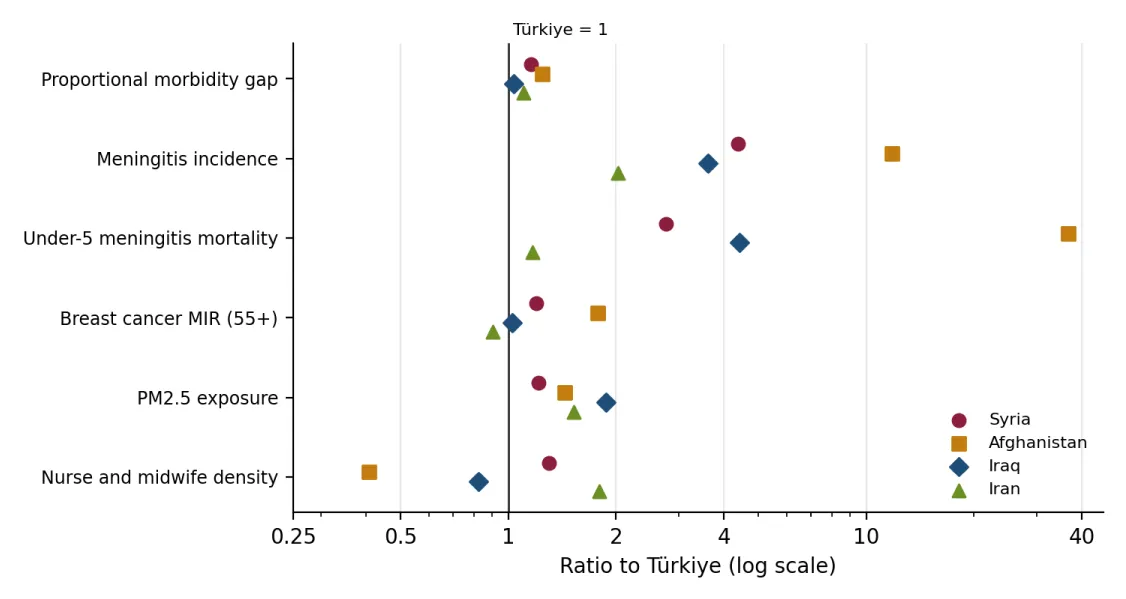
Figure 1: Ratio of selected indicators in countries of origin to the value for Türkiye, 2023. The vertical line indicates the value for Türkiye (ratio = 1). For all indicators except nurse and midwife density, values to the right of 1 indicate a less favourable situation. Source: IHME GBD 2023.
Among communicable diseases, the most pronounced difference was observed for meningitis. Meningitis incidence was 4.4 times that of Türkiye in Syria, 3.6 times in Iraq and 11.8 times in Afghanistan. Under-5 meningitis mortality was 2.8 times that of Türkiye in Syria, 4.4 times in Iraq and 37 times in Afghanistan. At the national level, this suggests that the vaccination status of children arriving from Afghanistan, in particular, warrants careful assessment. In terms of the health workforce, nurse and midwife density in Afghanistan was 41% of that in Türkiye, and physician density was one quarter. Although GBD estimates indicate a higher workforce density for Syria than for Türkiye, it should be noted that these estimates may not fully reflect the large-scale exodus of experienced health workers that followed systematic attacks on health care during the conflict [18].
Among non-communicable diseases, breast cancer mortality among women aged 55 years and older increased between 1990 and 2023 by 112% in Iraq, 61% in Syria and 45% in Afghanistan. Over the same period, it remained unchanged in Türkiye and decreased by 12% globally. The mortality-to-incidence ratio was 0.73 in Afghanistan and 0.49 in Syria, higher than in Türkiye (0.41), which may indicate more limited access to diagnosis and treatment at the national level. With regard to air pollution, PM2.5 exposure was higher than in Türkiye in all four countries of origin; in Iraq (49.5 µg/m³)
it was almost twice that of Türkiye. The 95% UIs of these estimates are given in Supplementary Table S1 (Figure 1).
Settlement pattern of Syrians in Türkiye and PM2.5 exposure
Of Syrians under temporary protection, 17.4% live in Istanbul, 14.0% in Gaziantep and 8.6% in Şanlıurfa. The six provinces bordering Syria (Hatay, Kilis, Gaziantep, Şanlıurfa, Mardin and Şırnak) host 33.6% of Syrians but only 8.9% of the host population. The share of Syrians in the provincial population is 27.5% in Kilis, 15.0% in Gaziantep, 11.1% in Hatay, and 9.6% in Şanlıurfa (Tables 2,3, Figure 2A). Most of the provinces where Syrians are most concentrated are also those with the highest PM2.5 levels: Kilis ranks 2nd, Gaziantep 7th, Hatay 9th and Şanlıurfa 12th for PM2.5.
| Table 2. Comparison of PM2.5 exposure between Syrians under temporary protection and the host population | |||
| Indicator | Syrians | Host population | Difference / ratio |
| Weighted mean PM2.5, 2023 (µg/m³) | 27.4 | 24.4 | +3.1 µg/m³ (+12.5%) |
| Weighted mean PM2.5, 2021–2023 average (µg/m³) | 27.7 | 24.6 | +3.1 µg/m³ (+12.6%) |
| Weighted mean PM2.5, excluding Istanbul (µg/m³) | 29.7 | 26.1 | +3.6 µg/m³ (+13.8%) |
| Living in provinces with PM2.5 > 25 µg/m³ (%) | 64.5 | 45.3 | 1.4-fold |
| Living in provinces with PM2.5 > 30 µg/m³ (%) | 41.0 | 18.3 | 2.2-fold |
| Living in provinces with PM2.5 > 35 µg/m³ (%) | 19.8 | 7.8 | 2.5-fold |
| Living in the most polluted quintile (16 provinces) (%) | 40.0 | 17.5 | 2.3-fold |
| Living in the 6 provinces bordering Syria (%) | 33.6 | 8.9 | 3.8-fold |
| Exposure was calculated by weighting provincial PM2.5 values by the provincial populations of each group. Provinces bordering Syria: Hatay, Kilis, Gaziantep, Şanlıurfa, Mardin, Şırnak. Sources: IHME GBD 2023 PM2.5 gridded estimates; Presidency of Migration Management (1 May 2025); TurkStat ABPRS 2024. Differences and percentage differences were calculated from unrounded means and then rounded; they may therefore differ by 0.1 µg/m³ from the difference between the rounded values shown (e.g., 27.4 − 24.4). Values are provincial-level estimates based on area-mean PM2.5 and do not represent individual exposure. The host population is the ABPRS population, which excludes persons under temporary protection. | |||
| Table 3. Provinces with the largest populations of Syrians under temporary protection and their PM2.5 levels. | |||||
| Province | Number of Syrians | Share of all Syrians (%) | Share of provincial population (%) | PM2.5 2023 (µg/m³) | PM2.5 rank (of 81) |
| Istanbul | 481,011 | 17.4 | 3.0 | 16.8 | 79 |
| Gaziantep | 385,894 | 14.0 | 15.0 | 35.1 | 7 |
| Şanlıurfa | 238,475 | 8.6 | 9.6 | 33.2 | 12 |
| Adana | 203,871 | 7.4 | 8.2 | 27.8 | 28 |
| Hatay | 194,556 | 7.1 | 11.1 | 34.5 | 9 |
| Mersin | 174,333 | 6.3 | 8.2 | 26.9 | 32 |
| Bursa | 159,950 | 5.8 | 4.7 | 21.4 | 60 |
| Konya | 113,453 | 4.1 | 4.6 | 24.7 | 43 |
| İzmir | 110,461 | 4.0 | 2.4 | 25.8 | 36 |
| Ankara | 80,493 | 2.9 | 1.4 | 21.2 | 62 |
| Kahramanmaraş | 78,332 | 2.8 | 6.5 | 33.2 | 13 |
| Kayseri | 73,177 | 2.7 | 4.8 | 27.1 | 30 |
| Kilis | 59,563 | 2.2 | 27.5 | 37.7 | 2 |
| Provinces are ranked by number of Syrians; Kilis was added as the province with the highest share of Syrians in its population. Share of provincial population = number of Syrians / (ABPRS population + number of Syrians). ABPRS excludes persons under temporary protection, so the two counts do not overlap. PM2.5 rank: 1 = highest. Sources: Presidency of Migration Management (1 May 2025); TurkStat ABPRS 2024; IHME GBD 2023. | |||||
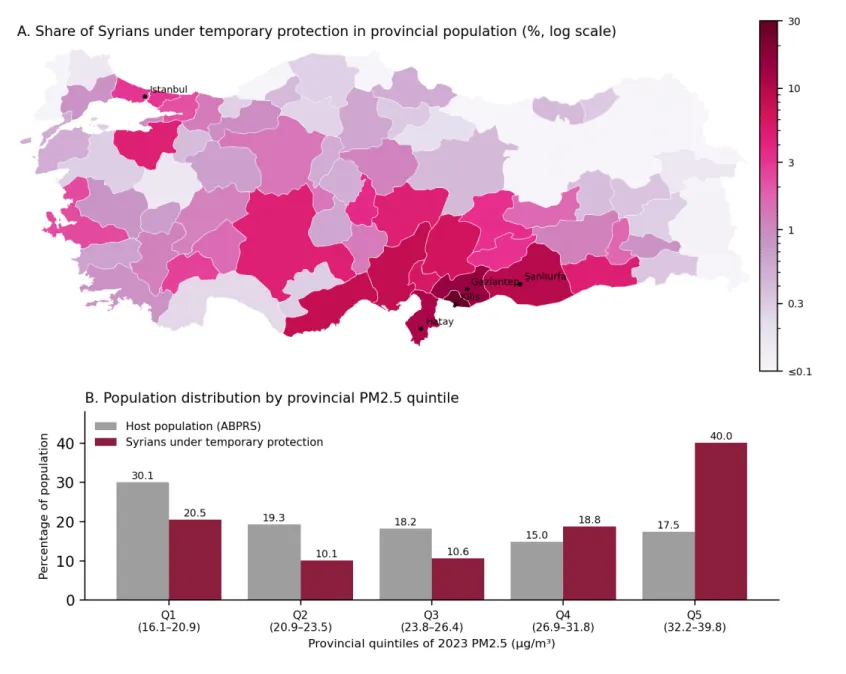
Figure 2: (A) Share of Syrians under temporary protection in the provincial population and (B) distribution of Syrians and the host population across provincial PM2.5 quintiles. Sources: Presidency of Migration Management (1 May 2025); TurkStat ABPRS 2024; calculated by the authors from IHME GBD 2023 PM2.5 gridded estimates.
In 2023, the population-weighted mean provincial PM2.5 level for Syrians was 27.4 µg/m³, compared with 24.4 µg/m³ for the host population. On average, Syrians lived in provinces with 3.1 µg/m³ (12.5%) higher estimated PM2.5 levels (calculated from unrounded means; see note to Table 2). Of Syrians, 19.8% lived in provinces where PM2.5 exceeded 35 µg/m³, the first WHO interim target (WHO, 2021), compared with 7.8% of the host population. When provinces were divided into quintiles by PM2.5 level, 40.0% of Syrians were residing in the 16 provinces of the most polluted quintile, compared with 17.5% of the host population (Figure 2B). At the provincial level, a positive association was found between the share of Syrians in the provincial population and PM2.5 level (Spearman’s ρ = 0.33; p = 0.003; n = 81), this unadjusted ecological association does not indicate individual exposure or a causal relationship. The difference persisted when the 2021–2023 average was used (27.7 vs. 24.6 µg/m³) and when Istanbul, which hosts the largest number of Syrians and has low PM2.5 levels, was excluded (29.7 vs. 26.1 µg/m³) (Table 2). The provincial distribution of Syrians changed little after May 2025: in the 13 provinces listed in Table 3, the share of all Syrians living in each province in July 2026 differed from that in May 2025 by at most 1.0 percentage point, and the rank correlation between the two distributions was 0.99 [17]. Because the largest decline occurred in Hatay (from 7.1% to 6.1%), a province with high PM2.5 levels, the exposure difference based on the most recent distribution may be marginally smaller.
When the current provincial distribution of Syrians was applied to 1990 PM2.5 values, the difference between the two groups was only 1.1 µg/m³. This finding suggests that the current exposure difference largely reflects the increase in pollution in southeastern provinces over the past 30 years rather than the settlement pattern alone; however, this counterfactual comparison is descriptive and does not account for changes in settlement over time.
This study shows that both communicable and non-communicable disease burdens in the main countries of origin of refugees and migrants in Türkiye are higher than in Türkiye, and that Syrians under temporary protection are concentrated in the most polluted provinces of Türkiye. Taken together, these ecological findings suggest that the health risks prevalent in the countries of origin may overlap with the environmental risks in the provinces of the host country where Syrians are concentrated, consistent with the view that migrant health is shaped jointly by conditions before, during and after migration [1].
Findings on origin-country profiles should be interpreted with caution. Current indicators in the countries of origin do not directly reflect the health status of refugees who have lived in Türkiye for many years. A global meta-analysis found that international migrants overall have lower all-cause mortality than host populations, supporting the healthy migrant hypothesis; however, the same study found higher mortality from infectious diseases and external causes, and no mortality advantage among asylum seekers [19]. Refugees who have lived in Türkiye for a long time also benefit from Türkiye’s vaccination and primary care services. On the other hand, the collapse of health services in Syria, including the targeting of health facilities and the exodus of health workers [18], together with interruptions during migration, trauma, and access barriers, may make some risks even higher than the origin-country average. The origin-country profile should therefore be used not as an individual risk estimate but as a roadmap of potential health needs to consider in nursing assessment. In particular, national disease-burden indicators of the countries of origin should not be read as measures of the health status of refugees and migrants living in Türkiye.
The meningitis findings are particularly important in this respect. The high under-5 meningitis mortality in the countries of origin is consistent with the disruption of vaccination programmes in these countries. Studies from Türkiye show that these gaps persist after arrival: in a survey of Syrian children aged 0–4 years in five provinces including Gaziantep, 22.4% had never been vaccinated, and one in five children born in Türkiye had never received any vaccine [20]. Completing vaccination status, particularly for Hib, pneumococcal conjugate and measles vaccines, is therefore a priority public health intervention. For breast cancer, rapidly rising mortality and high mortality-to-incidence ratios in the countries of origin are mirrored by clinical data from Türkiye: Syrian refugee women with breast cancer were less likely to receive adjuvant chemotherapy, radiotherapy and hormonal therapy and had shorter median overall survival than Turkish women (116 vs. 146 months) [21]. This underlines the need for special efforts to improve refugee women’s participation in screening and their access to early diagnosis and complete treatment.
The findings of the exposure analysis suggest, at the provincial level, that Syrians under temporary protection are disproportionately concentrated in the provinces of Türkiye with higher estimated PM2.5 levels, a pattern described in the environmental justice literature for other disadvantaged groups [11] and, more recently, for immigrants in Europe [13]. This inequality is related to the settlement of most Syrians in provinces near the border and to the increase in pollution in these provinces. Desert dust transport is a major contributor: the Southeastern Anatolia Region is affected frequently and intensely by long-range transport of dust from the Arabian Peninsula [15], and in Gaziantep, days with desert dust storms have been associated with increased emergency department visits for stroke [22]. However, the provincial-level analysis cannot capture differences within provinces. Within provinces, refugees may be more likely to live in low-income, crowded neighbourhoods close to industrial zones, in poorly insulated housing, and to use solid fuels for heating; The actual individual-level exposure difference may therefore differ from, and could be larger than, the provincial-level difference calculated in this study. Additional environmental risks should also be considered, as the February 2023 earthquakes affected the provinces where Syrians are concentrated. Measurements during debris removal after the earthquakes showed very high respirable dust concentrations and fibrous structures associated with asbestos [23], and residents of container cities may face prolonged exposure.
Implications for public health nursing
The findings can be considered within the framework of Leininger’s [24] transcultural nursing theory and the Minnesota Intervention Wheel [25]. At the individual and family level, nurses working in Migrant Health Centres, which provide primary care in Arabic with Syrian health personnel in provinces with large migrant populations [26], and in family health centres should conduct an initial assessment that takes into account origin-country-specific risks. This assessment should include checking vaccination status and completing missing vaccinations, screening for chronic diseases, referring women aged 40 years and older to breast cancer screening, and mental health assessment. Health education should be delivered in the native language, through interpreters or cultural mediators, and in a culturally sensitive manner.
At the community level, it is recommended that air quality and dust transport alerts be communicated in multiple languages, including Arabic, in provinces such as Gaziantep, Kilis, Şanlıurfa and Hatay where Syrians are concentrated, and air pollution is high, and that monitoring programmes be developed for refugees with conditions such as asthma and COPD and for refugee children. During home visits, indoor air quality, use of solid fuels for heating, ventilation, and crowded living conditions should be assessed. School nurses can play an active role in vaccination screening and respiratory health monitoring in schools with large numbers of refugee children.
At the system level, it is recommended that migration health data be collected disaggregated by country of origin, that environmental risks be considered in refugee health policies, and that the air quality monitoring network be strengthened in southeastern provinces. Including migration health, transcultural nursing, and environmental justice in nursing curricula, and sustaining the involvement of Syrian health workers as cultural mediators in health services, may increase the effectiveness of services for these groups. During the ongoing period of returns, completing vaccinations and chronic disease treatments before return and providing individuals with their health records are important for continuity of care.
Limitations
This study has an ecological design, and its findings refer to countries, provinces, and population groups, not to individuals [27]. First, the origin-country indicators are national estimates for the populations living in those countries. They do not measure the health status of refugees and migrants living in Türkiye, who may differ from these populations because of selective migration (the healthy migrant effect), time since arrival, and access to health services in Türkiye. Inferring the health status or individual risk of refugees and migrants from these indicators would constitute an ecological fallacy.
Second, GBD estimates are modelled. In conflict-affected settings such as Syria, Afghanistan and Iraq, primary data are sparse, which widens uncertainty intervals and may introduce bias; the health workforce estimate for Syria is an example. The point estimates in Table 1 should be read together with the 95% UIs in Supplementary Table S1, and small differences between countries may not be meaningful.
| Supplementary Table S1: Point estimates and 95% uncertainty intervals (UIs) for the indicators in Table 1, 2023 | ||||||
| Indicator | Türkiye | Syria | Afghanistan | Iraq | Iran | Global |
| Life expectancy (years) ᵃ | 76.1 (–) | 75.4 (–) | 68.5 (–) | 71.1 (–) | 78.8 (–) | 73.8 (–) |
| Healthy life expectancy (years) | 65.1 (62.0–67.9) | 62.8 (59.3–65.8) | 56.2 (52.9–59.1) | 60.5 (57.6–63.0) | 66.3 (62.8–69.3) | 63.1 (60.2–65.6) |
| Proportional morbidity gap (%) ᵇ | 14.4 (–) | 16.7 (–) | 17.9 (–) | 14.9 (–) | 15.9 (–) | 14.5 (–) |
| Morbidity gap, females (years) | 12.9 (9.6–16.7) | 14.0 (10.5–18.1) | 13.1 (9.5–17.1) | 12.3 (9.1–15.9) | 14.1 (10.7–18.1) | 12.1 (9.2–15.6) |
| Nurses and midwives (per 10,000) ᵃ | 17.2 (–) | 22.3 (–) | 7.0 (–) | 14.2 (–) | 30.9 (–) | 44.1 (–) |
| Physicians (per 10,000) | 16.1 (11.4–22.4) | 20.5 (14.5–28.8) | 4.0 (1.9–7.9) | 11.1 (7.4–16.1) | 18.9 (13.8–25.2) | 18.8 (16.3–22.5) |
| Meningitis incidence (per 100,000) ᶜ | 4.7 (3.9–5.8) | 20.6 (17.3–24.2) | 55.4 (47.3–65.5) | 17.0 (14.1–20.2) | 9.5 (7.9–11.5) | 31.3 (27.3–36.4) |
| Meningitis mortality (per 100,000) | 0.34 (0.25–0.46) | 1.31 (1.00–1.84) | 6.89 (4.13–11.33) | 1.25 (0.90–1.74) | 0.63 (0.46–0.96) | 3.21 (2.51–4.15) |
| Under-5 meningitis mortality (per 100,000) | 0.82 (0.49–1.31) | 2.26 (1.33–3.56) | 30.11 (14.72–55.40) | 3.63 (1.87–5.92) | 0.96 (0.58–1.49) | 13.46 (8.29–23.20) |
| Breast cancer incidence, age 55+ (ASR) | 123.5 (96.4–156.7) | 88.8 (66.5–116.5) | 35.8 (20.7–61.4) | 244.7 (156.9–345.2) | 92.5 (72.0–114.7) | 160.0 (137.6–180.0) |
| Breast cancer MIR, age 55+ ᵃ | 0.41 (–) | 0.49 (–) | 0.73 (–) | 0.42 (–) | 0.37 (–) | 0.37 (–) |
| Change in breast cancer mortality, age 55+, 1990–2023 (%) ᵃ | −0.1 (–) | +61.1 (–) | +45.3 (–) | +112.4 (–) | +9.9 (–) | −12.4 (–) |
| PM2.5 (µg/m³) | 26.4 (26.0–26.8) | 32.1 (31.5–32.5) | 37.9 (37.6–38.4) | 49.5 (48.9–50.0) | 40.2 (39.7–40.8) | 32.9 (32.8–33.0) |
| NO₂ (ppb) | 10.7 (5.7–16.8) | 7.6 (2.6–13.7) | 5.7 (0.8–11.9) | 8.9 (3.9–15.0) | 9.9 (4.9–16.0) | 7.3 (1.9–14.0) |
| Values are GBD 2023 point estimates with 95% UIs in parentheses. (–): UI not available. ᵃ Indicator derived by the authors from GBD estimates (life expectancy = healthy life expectancy + morbidity gap; nurses and midwives = sum of nursing and midwifery personnel; MIR = deaths/incidence; percentage change from 1990 and 2023 rates); UIs cannot be derived from the published lower and upper bounds. ᵇ UIs are not reported in the source dataset. ᶜ Point estimates are the sum of the aetiology-specific incidence estimates; UIs are those of the total meningitis incidence estimate in the GBD Results Tool. ASR: age-standardised rate (per 100,000 women); MIR: mortality-to-incidence ratio. Source: IHME GBD 2023 morbidity gap, human resources for health, meningitis, breast cancer and air pollution datasets. | ||||||
Third, exposure was assigned at the provincial level using area means. This approach does not capture where people live within provinces—refugees may be concentrated in particular neighbourhoods—or indoor, occupational and heating-related exposures, and therefore entails exposure misclassification, which may differ between the two groups. Results may also depend on the spatial unit chosen (the modifiable areal unit problem) [28]. The host-population exposure calculated with this method (24.4 µg/m³) is lower than the GBD national population-weighted value calculated at grid level (26.4 µg/m³),
mainly because area means give equal weight to sparsely populated, less polluted cells; absolute values should therefore not be compared with GBD national figures, and the relative difference between the two groups is the more informative measure. Province-specific uncertainty in the gridded PM2.5 estimates was not propagated to the group means.
Fourth, exposure (2023), host-population (2024), and Syrian population (May 2025) data refer to different time points. The sensitivity analysis using 2021–2023 PM2.5 and the comparison with the July 2026 provincial distribution suggest that these differences are unlikely to change the direction of the findings, but returns since 2025 have reduced the size of the Syrian population. The analysis covers only registered Syrians under temporary protection and does not include unregistered migrants or migrants of other nationalities; Syrians with residence permits or Turkish citizenship are counted in the host population, which may slightly underestimate the difference between the groups.
Fifth, the provincial-level association between the share of Syrians and PM2.5 is unadjusted, does not account for spatial autocorrelation, and may be confounded by factors such as proximity to the border, urbanisation, industrial activity, the impact of the 2023 earthquakes and labour-market opportunities. It therefore does not establish individual exposure levels or a causal relationship between settlement and pollution. Finally, the study examines exposure only; it does not assess individual health outcomes, and it does not estimate the disease burden attributable to PM2.5 among refugees [29-33].
According to national GBD estimates, the duration of life lived in poor health, the burden of meningitis and breast cancer mortality are higher in the main countries of origin of refugees and migrants in Türkiye than in Türkiye. Syrians under temporary protection are concentrated in the provinces with the highest estimated PM2.5 levels, and their population-weighted mean provincial PM2.5 level is 12.5% higher than that of the host population. Because these are ecological, provincial-level findings, they do not establish individual exposure levels, individual health outcomes, or causal relationships, and origin-country indicators do not directly represent the health status of refugees and migrants living in Türkiye. Comprehensive nursing assessment that takes origin-country-specific health risks into account, completing vaccination status, improving access to chronic disease and cancer screening, multilingual and culturally sensitive health education, and reducing environmental risks are priority areas for public health nursing. Future studies should examine vaccination, chronic disease and cancer screening status among refugees and migrants using individual-level health data, and conduct exposure studies that consider within-province settlement and indoor air quality.
Declarations
Ethics approval: Not required. The study used only publicly available, aggregated and non-identifiable secondary data (IHME Global Burden of Disease 2023 estimates, Presidency of Migration Management provincial statistics and TurkStat population data).
Data availability: All data used are publicly available from the Global Health Data Exchange (IHME), the Presidency of Migration Management and TurkStat. The provincial exposure estimates and analysis code are available from the author upon reasonable request.
Funding: This research received no specific grant from any funding agency in the public, commercial or not-for-profit sectors.
Author contribution: Ayşe Elkoca was solely responsible for the conceptualisation, methodology, data curation, formal analysis, visualisation, writing of the original draft, and review and editing of the manuscript.
Acknowledgement: The author thanks the Institute for Health Metrics and Evaluation and the Global Burden of Disease Collaborative Network for making the data publicly available.
Use of AI-assisted technologies: During the preparation of this work, the author used Claude (Anthropic) to assist with data processing, drafting, literature searching and translation into English. After using this tool, the author reviewed, verified and edited the content as needed and takes full responsibility for the content of the publication.
- Abubakar I, Aldridge RW, Devakumar D, Orcutt M, Burns R, Barreto ML, et al. The UCL–Lancet Commission on Migration and Health: the health of a world on the move. Lancet. 2018;392(10164):2606–2654. Available from: https://doi.org/10.1016/S0140-6736(18)32114-7
- World Health Organization. WHO global air quality guidelines: particulate matter (PM2.5 and PM10), ozone, nitrogen dioxide, sulfur dioxide and carbon monoxide. Geneva: WHO; 2021.
- Barış M, Sert G, Önder O. Ethical challenges in accessing and providing healthcare for Syrian refugees in Türkiye. Bioethics. 2025;39(1):49–57. Available from: https://doi.org/10.1111/bioe.13233
- Uwishema O, Kwan SHA, Sengar AS, Patel RP, Kazan Z, Choudhary K. Addressing the health needs of refugees and migrants in Türkiye: a literature review. Health Sci Rep. 2025;8(2):e70442. Available from: https://doi.org/10.1002/hsr2.70442
- UNHCR. Global trends: forced displacement in 2024. Copenhagen: United Nations High Commissioner for Refugees; 2025.
- Presidency of Migration Management. Distribution of Syrians under temporary protection by province, 1 May 2025. Ankara: Republic of Türkiye Ministry of Interior; 2025.
- European Commission. EU support to refugees in Türkiye: priority area brief – migration and border management. Briefing note, June 2026. Brussels: European Commission; 2026. Available from: https://www.eeas.europa.eu/sites/default/files/2026/documents/HealthBNJUNE2026.pdf
- Presidency of Migration Management. Temporary protection statistics. Ankara: Republic of Türkiye Ministry of Interior; 2026. Available from: https://www.goc.gov.tr/gecici-koruma5638 [accessed August 2026].
- Turkish Statistical Institute (TurkStat). Address-Based Population Registration System results, 2024. Ankara: TurkStat; 2025.
- Tuncay Alpanda B, Özen İC, Bump JB. Shelter from the storm: health service access and utilization among Syrian refugees in Turkey. J Public Health (Berl). 2022. Available from: https://doi.org/10.1007/s10389-022-01697-0
- Mohai P, Pellow D, Roberts JT. Environmental justice. Annu Rev Environ Resour. 2009;34:405–430.
- GBD 2021 Risk Factors Collaborators. Global burden and strength of evidence for 88 risk factors in 204 countries and 811 subnational locations, 1990–2021: a systematic analysis for the Global Burden of Disease Study 2021. Lancet. 2024;403(10440):2162–2203. Available from: https://doi.org/10.1016/S0140-6736(24)00933-4
- Ehler I, Bader F, Rüttenauer T, Best H. The air pollution disadvantage of immigrants in Germany: partly a matter of urbanity. Eur Sociol Rev. 2023. Available from: https://doi.org/10.1093/esr/jcad046
- Hay SI, Nam P, Saqib H, McLaughlin SA, Bisignano C, Ostroff SM, et al. Global, regional, and national trends in the morbidity gap and contributing diseases, injuries, and risk factors, 1990–2023: a systematic analysis for the Global Burden of Disease Study 2023. Lancet Public Health. 2026.
- Baltaci H, Ezber Y. Characterization of atmospheric mechanisms that cause the transport of Arabian dust particles to the southeastern region of Turkey. Environ Sci Pollut Res. 2022;29:22771–22784. Available from: https://doi.org/10.1007/s11356-021-17526-y
- Turkish Statistical Institute (TurkStat). Türkiye: population estimates metadata, 2022. In: United Nations Demographic Yearbook metadata. New York: United Nations Statistics Division; 2023. Available from: https://mdgs.un.org/unsd/demographic-social/products/dyb/documents/metadata/2023/Turkiye-2022-PE-Metadata.pdf
- Asylum Information Database (AIDA). Country report: Türkiye – statistics. Brussels: European Council on Refugees and Exiles; 2026 [last updated 30 July 2026]. Available from: https://asylumineurope.org/reports/country/turkiye/statistics/
- Fouad FM, Sparrow A, Tarakji A, Alameddine M, El-Jardali F, Coutts AP, et al. Health workers and the weaponisation of health care in Syria: a preliminary inquiry for The Lancet–American University of Beirut Commission on Syria. Lancet. 2017;390(10111):2516–2526. Available from: https://doi.org/10.1016/S0140-6736(17)30741-9
- Aldridge RW, Nellums LB, Bartlett S, Barr AL, Patel P, Burns R, et al. Global patterns of mortality in international migrants: a systematic review and meta-analysis. Lancet. 2018;392(10164):2553–2566. Available from: https://doi.org/10.1016/S0140-6736(18)32781-8
- Öztaş D, Kurt B, Akbaba M, Akyol M, Mollahaliloğlu S, Topaç O. Vaccination rates for Syrian population under temporary protection in Turkey. Cent Eur J Public Health. 2020;28(2):130–134. Available from: https://doi.org/10.21101/cejph.a5543
- Atag E, Gokcay S, Tanrikulu Simsek E, Aslan F, Yetisir AE, Sari M. Syrian refugee and Turkish women with breast cancer: a comparison of clinicopathological features and survival. Arch Iran Med. 2023;26(1):29–35. Available from: https://doi.org/10.34172/aim.2023.05
- Oktay MM, Al B, Boğan M, Kul S, Gümüşboğa H, Bayram H. Impact of desert dust storms, PM10 levels and daily temperature on mortality and emergency department visits due to stroke. Front Public Health. 2023;11:1218942. Available from: https://doi.org/10.3389/fpubh.2023.1218942
- Oral T, Ensari Özay M, Uçan R, Aker D, Can E, Altınten B. Measurement and evaluation of dust concentrations in the air after the Kahramanmaraş earthquake in Turkey. Int J Environ Res Public Health. 2025;22(4):649. Available from: https://doi.org/10.3390/ijerph22040649
- Leininger MM. Culture care diversity and universality: a theory of nursing. New York: National League for Nursing; 1991.
- Keller LO, Strohschein S, Lia-Hoagberg B, Schaffer MA. Population-based public health interventions: practice-based and evidence-supported. Part I. Public Health Nurs. 2004;21(5):453–468.
- Republic of Türkiye Ministry of Health. SIHHAT Project: health services. Ankara: Ministry of Health; 2025. Available from: https://sihhatproject.saglik.gov.tr [accessed 29 September 2026].
- Morgenstern H. Ecologic studies in epidemiology: concepts, principles, and methods. Annu Rev Public Health. 1995;16:61–81. Available from: https://doi.org/10.1146/annurev.pu.16.050195.000425
- Openshaw S. The modifiable areal unit problem. Concepts and Techniques in Modern Geography No. 38. Norwich: Geo Books; 1984.
- GBD 2023 Breast Cancer Collaborators. Global, regional, and national burden of breast cancer among females, 1990–2023, with forecasts to 2050: a systematic analysis for the Global Burden of Disease Study 2023. Lancet Oncol. 2026;27:302–326.
- GBD 2023 Human Resources for Health Collaborators (Knight M, Bienhoff K, Bhoomadevi A, et al.). Measuring the composition and availability of human resources for health by sex in 204 countries and territories, 1990–2023, and workforce gaps for universal health coverage: a systematic analysis for the Global Burden of Disease Study 2023. Lancet Public Health. 2026;11:e604–e629.
- GBD 2023 Meningitis & Antimicrobial Resistance Collaborators. Global, regional, and national burden of meningitis, its risk factors, and aetiologies, 1990–2023: a systematic analysis for the Global Burden of Disease Study 2023. Lancet Neurol. 2026;25(5):451–468.
- Global Burden of Disease Collaborative Network. Global Burden of Disease Study 2023 (GBD 2023) Air Pollution Exposure Estimates and Risk Curves 1990–2023. Seattle, United States of America: Institute for Health Metrics and Evaluation (IHME); 2026.
- World Health Organization. World report on the health of refugees and migrants. Geneva: WHO; 2022.