
More Information
Submitted: June 03, 2026 | Accepted: June 12, 2026 | Published: May 15, 2026
Citation: Lifschitz M, Lifschitz N. Allergic Urticaria (Hives) during Hemodialysis. Arch Case Rep. 2026; 10(6): 58-59. Available from:
https://dx.doi.org/10.29328/journal.acr.1001189
DOI: 10.29328/journal.acr.1001189
Copyright license: © 2026 Lifschitz M, et al. This is an open access article distributed under the Creative Commons Attribution License, which permits unrestricted use, distribution, and reproduction in any medium, provided the original work is properly cited.
Keywords: Hemodialysis; Allergic urticarial; Heparin; Clexane
Abbreviations: Hgb: Hemoglobin; PTH: Parathyroid Hormone; K: Potassium; Ca: Calcium

Allergic Urticaria (Hives) during Hemodialysis
Meyer Lifschitz* and Nechama Lifschitz2*
92/8 Bayet Vegan, Jerusalem, 96427 Israel
*Corresponding author: Meyer Lifschitz, MD, 92/8 Bayet Vegan, Jerusalem, 96427 Israel, Email: [email protected]
This case report concerns a patient on hemodialysis who developed itching and urticaria (hives) on his skin after several months of starting hemodialysis. There had been no new foods ingested or medicines initiated in the recent past. Since the only medicine given during his hemodialysis treatments was heparin, and since allergic reactions to heparin are known, a presumed diagnosis of heparin allergy was made. His subsequent hemodialysis treatments used clexane, in place of heparin as an anticoagulant, and no subsequent allergic reactions developed.
Hemodialysis is one of the main lifesaving treatments for kidney failure. Most patients receive this treatment 3 times/ week. Depending on their particular condition certain medicines are regularly given to adjust factors beyond what hemodialysis does. Anticoagulation with heparin is routinely used during these treatments. This case describes a case of presumed recurrent heparin allergy successfully treated by replacing heparin with clexane.
The patient is a 63 year old gentleman with polycystic kidney disease who was started on hemodialysis in January 2015. He works daily in construction and with the exception of an episode of acute tonsillitis with a peritonsillar abscess and progressive renal insufficiency he has been healthy most of his adult life. He is a strict vegetarian. He was followed in an outpatient Nephrology clinic for his renal insufficiency and when his creatinine reached 10.9 mg% and nausea and vomiting developed he was started on outpatient hemodialysis with a right subclavial permacath for access. At the time dialysis was started he had hypertension 154/85, anemia (Hgb 5.6), hyperphosphatemia (8.7 mg%), hyperuricemia (10.4 mg%) with a history of gout in his big toe, mild metabolic acidosis with a pH of 7.32 and bicarbonate of 16 mEq/L and hyperparathyroidism (PTH 1880). After the first week of dialysis he was regularly dialyzed 3 times/ week for 4 hours each with standard dose heparin as an anticoagulant. Dialysis was performed with a Fresenius Medical Care model 5008S using disposable tubing and filters without reuse. Routine dialysate was Corosol D871 with K of 2 mEq/l and Ca of 1.5 mM/l. Medications included Venofer (intravenous Iron sucrose) 100 mg/week, Recormon (Epoetin beta) 5000 units/ week, calcium carbonate 1200 mg 3 times/day, amlodipine 5 mg/day and alpha D3 (Alphacalcidol) starting with 0.25 and then 0.5 ucg/day. When his Hgb approached 10 his Recormon was discontinued. Starting in April, near the end of dialysis, he would complain of itching and a few small bumps developed on his forearms. After dialysis they disappeared and his routine dialysis filter was changed to another manufacturer on the possibility that this was the cause. For the next few weeks he would regularly complain of itching during dialysis. An antihistamine was recommended initially before dialysis, and then daily, with no change in his itching symptoms. On May 28, 2015 he complained of severe itching and bumps on his skin on both forearms (Figure 1), but more pronounced on the right forearm. Dialysis was stopped early and within 30 minutes his rash (hives) had disappeared. A review of his dialysis record indicated that no medications had been given during that dialysis treatment—i.e. no Venofer and his Recormon had been discontinued 2 months earlier. No other patients in this dialysis unit had similar problems. He had no other symptoms, i.e. no wheezing or change in vital signs. Platelet counts routinely were normal. In the absence of other possibilities, a presumed diagnosis of recurrent heparin allergy was made. Subsequent hemodialysis sessions have used Clexane (Enoxaparin) 40 mg as an anticoagulant with no recurrence of the rash or itching for more than 3 years.
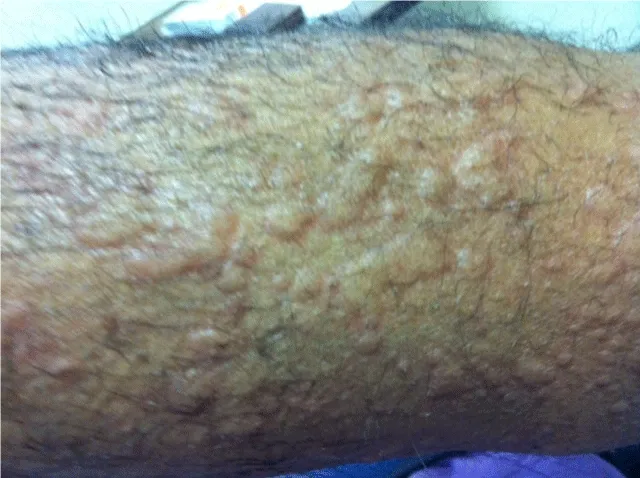
Figure 1: Figure of the forearm of the patient with obvious bumps (urticaria, hives) on his arm associated with severe itching, the patient’s skin is naturally dark so no change in color, such as redness, was discernable.
Heparin allergic reactions have been frequently reported in the literature [1,2] but this is usually in discussion of using heparin for cardiopulmonary bypass. In dialysis patients there was an epidemic of heparin reactions due to contaminants in the heparin in 2008 [3] and heparin induced thrombocytopenia is regularly reported in dialysis patients [2,4], but other heparin allergic reactions in dialysis seem to be rare. Although cross reactivity between heparin and low molecular weight heparins has been reported [5], to date, this has not occurred in this patient.
When the symptoms of itching and urticaria first developed, a careful history was taken to determine if any new foods or medicines had been taken. Since the symptoms only occurred during hemodialysis, there was a strong suspicion that the symptoms were related to the dialysis treatment. Since only this patient, and none others in the dialysis unit, had these symptoms, concern was focused on his specific treatment rather than the dialysis equipment, or cleaning, or preparation might be the cause. The dialysis solutions are mixtures of water, salts and sugars and thus unlikely to be responsible. Medicines are frequently the source for allergic reaction [2], but review of this patient’s medicines demonstrated no new medicines and no medicines taken during these dialysis treatments. Since heparin is routinely used during hemodialysis to prevent the blood from clotting in the dialysis tubing, and heparin is known to cause allergic reactions [2], heparin being the cause of this patient’s symptoms seemed likely. Since replacement of heparin with clexane stopped the symptoms, it seemed likely that heparin was the cause. To prove this, it would have been necessary to rechallenge the patient with heparin, but since his symptoms had been increasing with time, readministration of heparin might have led to a more severe allergic reaction, and was thus not undertaken. Using clexane in place of heparin was safe and effective as no allergic reaction or urticaria occurred in subsequent hemodialysis treatments for more than 3 years.
A patient is described who developed allergic urticaria (hives) with each dialysis, several months after starting hemodialysis. A careful search for the source for this allergic reaction ultimately focused on the heparin used for anticoagulation. Replacement of the heparin with clexane stopped the development of urticaria and lead to a presumed conclusion of heparin associated allergic urticaria.
- Smith RE, Townsend GE, Berry BR, Bowen T. Enoxaparin for unstable angina and ancrod for cardiac surgery following heparin allergy. Annals of Pharmocotherapy 1996; 30: 476-480. Available from: https://doi.org/10.1177/106002809603000508
- Butani L and Calogiuri G. Hypersensitivity reactions in patients receiving hemodialysis. Annals of Allergy, Asthma and Immunology 2017; 118: 680-684. Available from: https://doi.org/10.1016/j.anai.2017.04.006
- Blossom DB, Kallen AJ, Patel PR, Elward A, Robinson L, Gao G, et al. Outbreak of Adverse Reactions Associated with Contaminated Heparin NEJM 2008; 359: 2674-2684. Available from: https://doi.org/10.1056/nejmoa0806450
- Shavit L, Bar-Lev M, Lifschitz M, Fink D, Rodenski B, Slotki I. Incidence and clinical significance of heparin induced antibodies in chronic hemodialysis patients and cardiac surgery patients. ASAIO 34(12): 1172-1178, 2011. Available from: https://doi.org/10.5301/ijao.5000020
- Grassengger A, Fritsch P Reider N. Delayed-Type hypersensitivity and cross-reactivity to Heparins and Danaparoid: A Prospective Study. Dermatologic Surgery 2001; 27: 47-52. Available from: https://pubmed.ncbi.nlm.nih.gov/11231243/